Binance has one of the most complex pricing architectures in global crypto — and understanding it matters more than ever. The platform's fee structure is not a simple flat rate; it's a dual-engine VIP system where your 30-day trading volume and your BNB token holdings together determine every basis point you pay. Miss either threshold, and your tier drops. This is the complete diagnostic.
The dual-engine client structure
Most brokers offer tiered pricing based on a single variable — trading volume. Binance requires two independent metrics to be satisfied simultaneously. Think of it as a lock-and-key system: volume is the lock, BNB holdings are the key. You need both open at the same time to move up a tier.
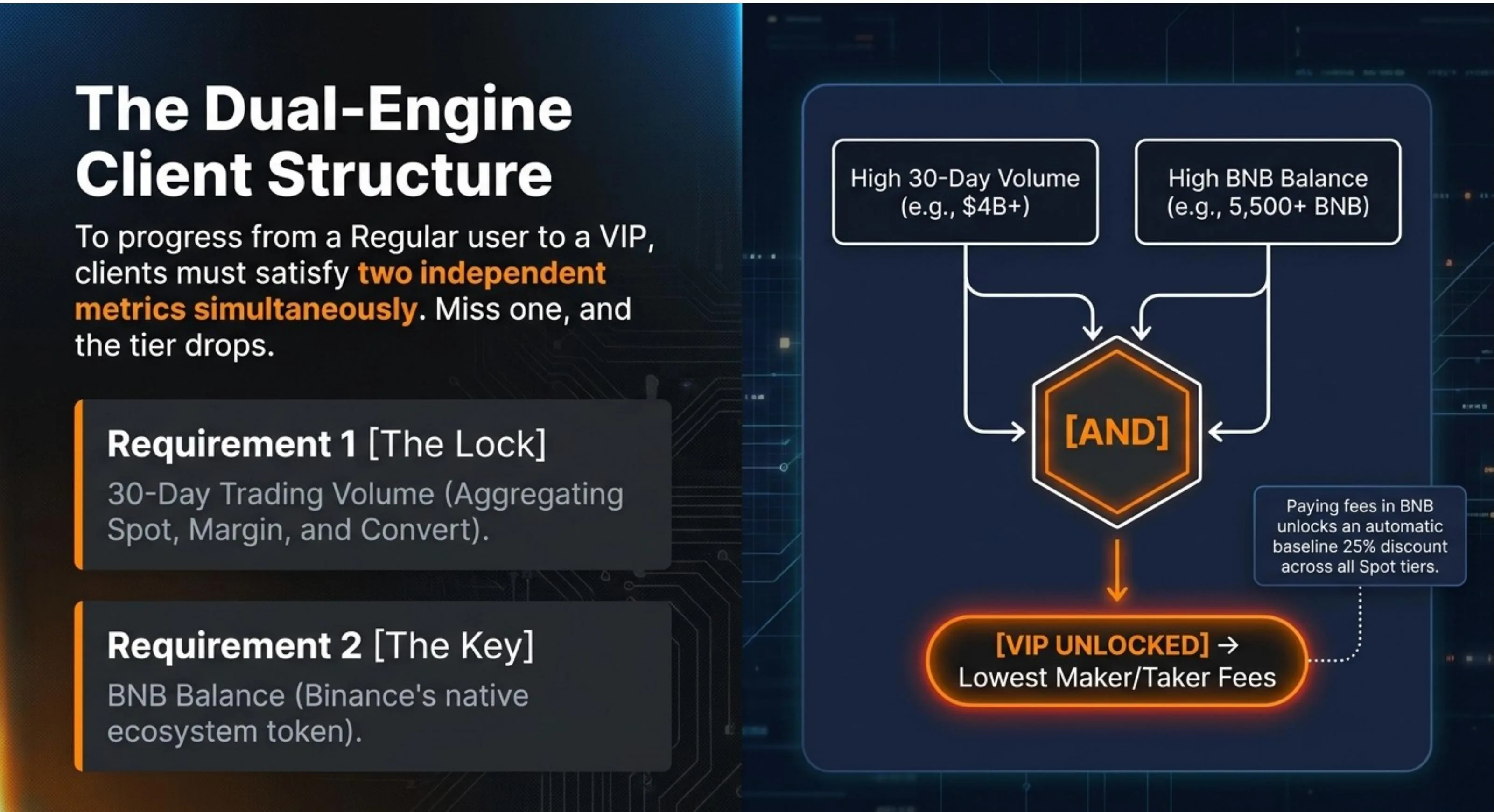
- Requirement 1 — 30-Day Trading Volume [The Lock]: Binance aggregates Spot, Margin, and Convert volume across the trailing 30 days. OTC trades count at a 4× multiplier. USDC pairs receive slightly tighter base rates.
- Requirement 2 — BNB Balance [The Key]: You must maintain a minimum BNB balance in your account. BNB is Binance's native ecosystem token, and holding it also unlocks a baseline 25% discount when you elect to pay fees in BNB — automatically applied across all Spot tiers.
The VIP spot ladder: volume, BNB, and the maker/taker spread
Binance's spot fee ladder spans from Regular users all the way to VIP 9. The spread between the top and bottom is extreme — regular users pay 12× more than VIP 9 clients paying in BNB. Here are the key tier anchors:
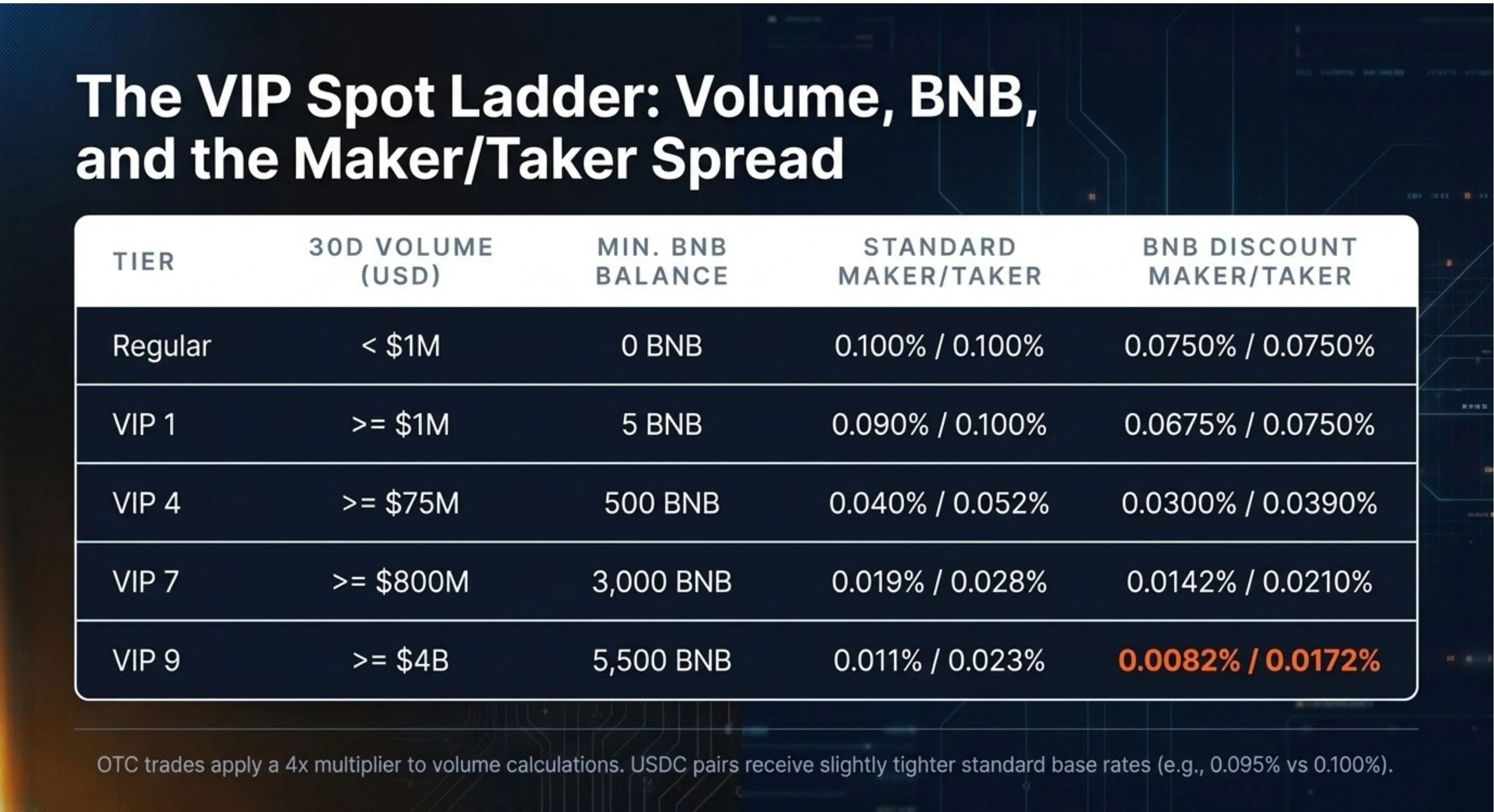
The maker/taker asymmetry deserves attention. Binance — like most central-limit-order-book exchanges — rewards liquidity provision: maker fees are consistently lower than taker fees at every tier. At VIP 9 standard, the maker fee (0.011%) is roughly half the taker fee (0.023%). Liquidity-providing strategies benefit disproportionately from climbing the ladder.
Cross-asset master fee matrix
The VIP spot ladder covers crypto spot pairs, but Binance's fee architecture extends across multiple asset classes, each with its own pricing logic. Options, P2P, fiat pairs, and cash deposits all work differently:
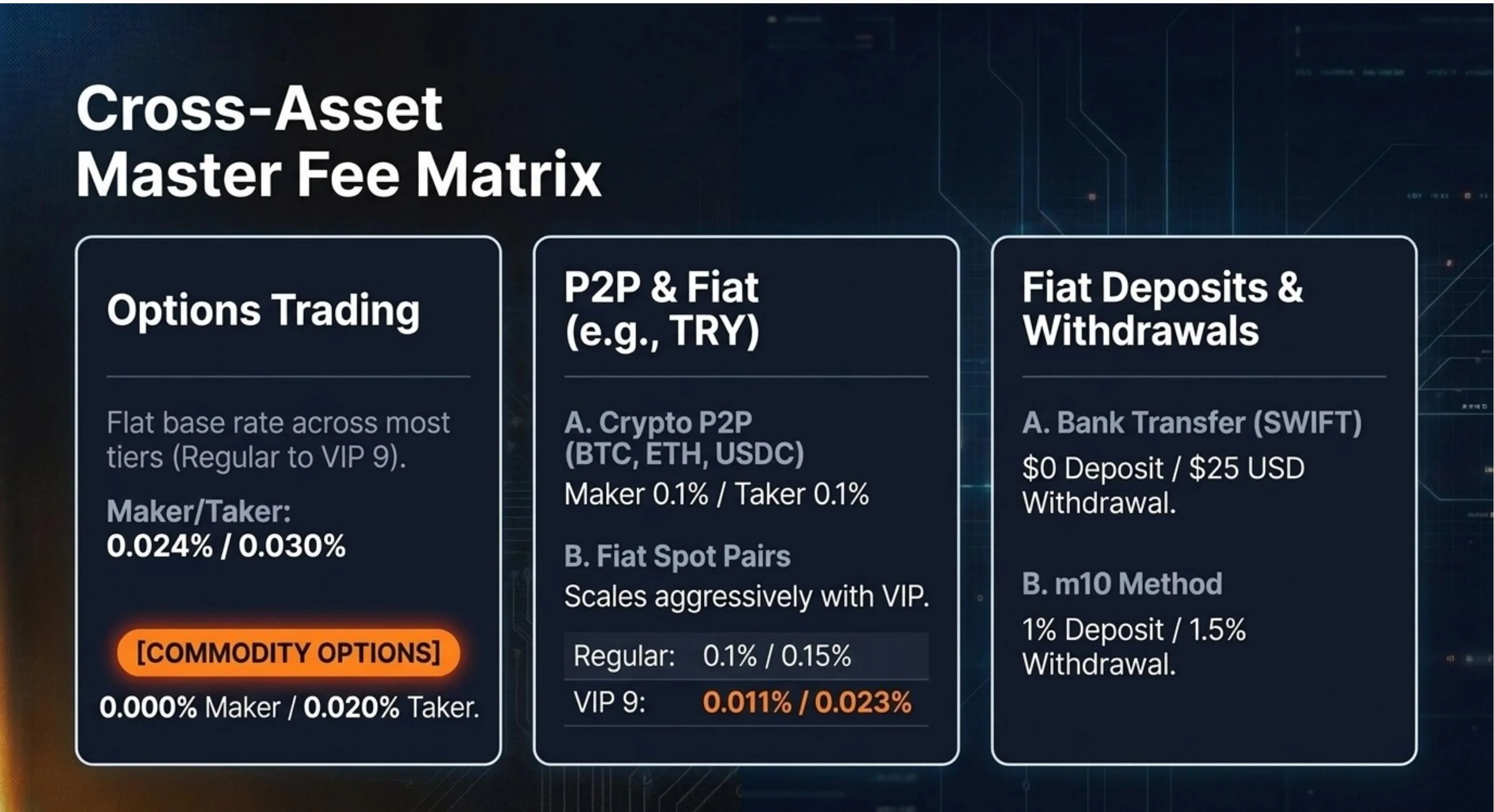
- Options Trading: Flat 0.024% maker / 0.030% taker across most tiers (Regular to VIP 9). Commodity options are priced differently: 0.000% maker / 0.020% taker.
- P2P & Fiat (e.g., TRY pairs): Crypto P2P (BTC, ETH, USDC) costs 0.1% maker / 0.1% taker flat. Fiat spot pairs scale aggressively — from 0.1%/0.15% at Regular to 0.011%/0.023% at VIP 9.
- Fiat Deposits & Withdrawals: Bank transfer (SWIFT) — $0 deposit, $25 withdrawal. The m10 method charges 1% on deposit and 1.5% on withdrawal.
Anatomy of a US equity trade (direct shares)
Binance has expanded into zero-commission US equities — a feature designed to deepen ecosystem lock-in rather than generate direct fee revenue. The funding, execution, regulatory, and post-trade steps each carry distinct cost implications:
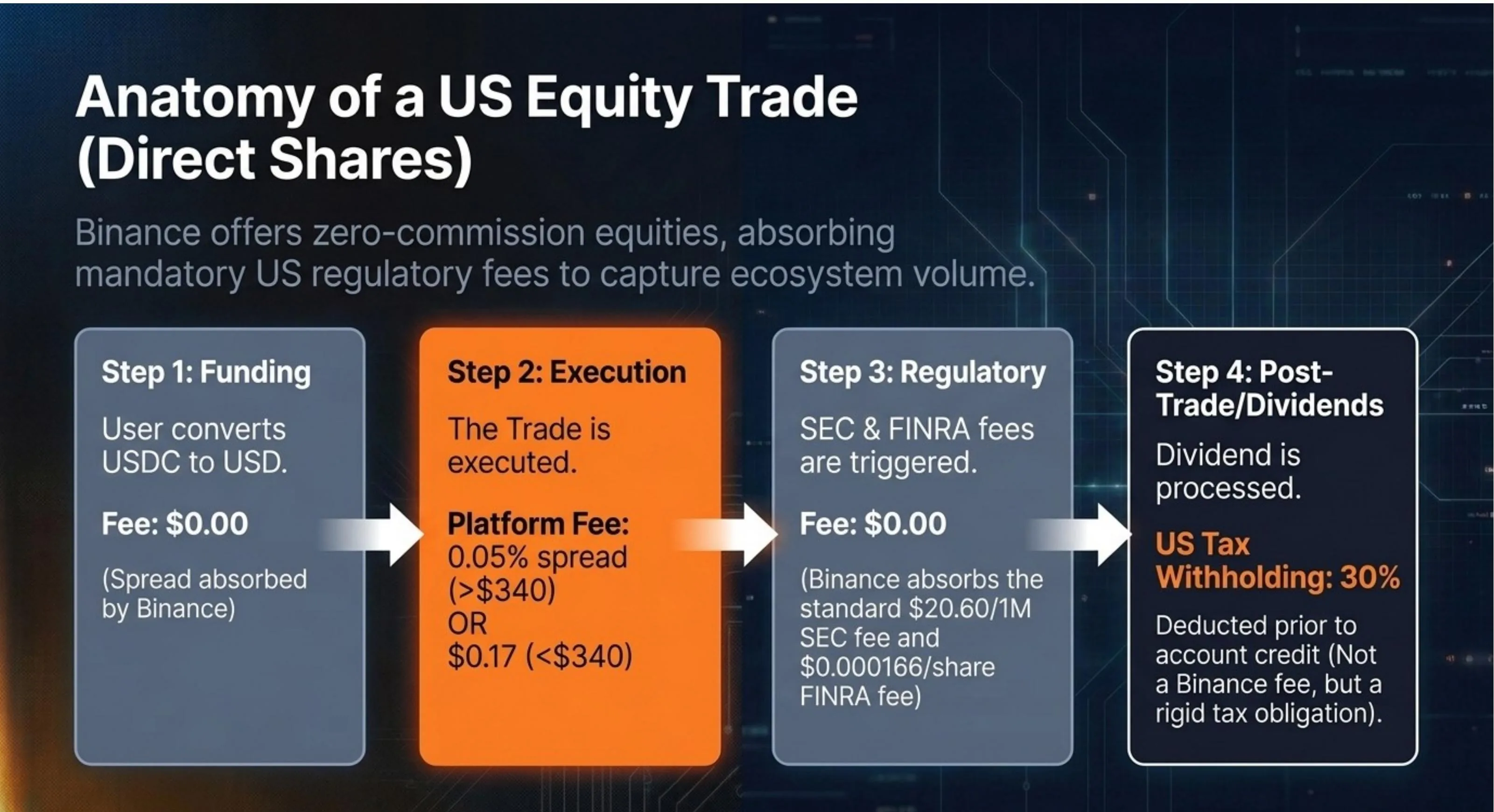
- Step 1 — Funding: Users convert USDC to USD. The spread is absorbed by Binance ($0.00 to the user).
- Step 2 — Execution: The platform fee is a 0.05% spread on orders above $340, or a flat $0.17 for smaller orders.
- Step 3 — Regulatory: Binance absorbs both the standard SEC fee ($20.60 per $1M notional) and the FINRA TAF ($0.000166/share). These appear as $0.00 to the user.
- Step 4 — Post-Trade/Dividends: Dividends trigger a 30% US tax withholding — a rigid legal obligation deducted before account credit. This is not a Binance fee and cannot be waived by any platform.
Global availability & regulatory footprint
Binance's geographic availability is one of the most important — and most misunderstood — aspects of the platform. Not every user in every country can access the same Binance product set, and several major markets are entirely off-limits:
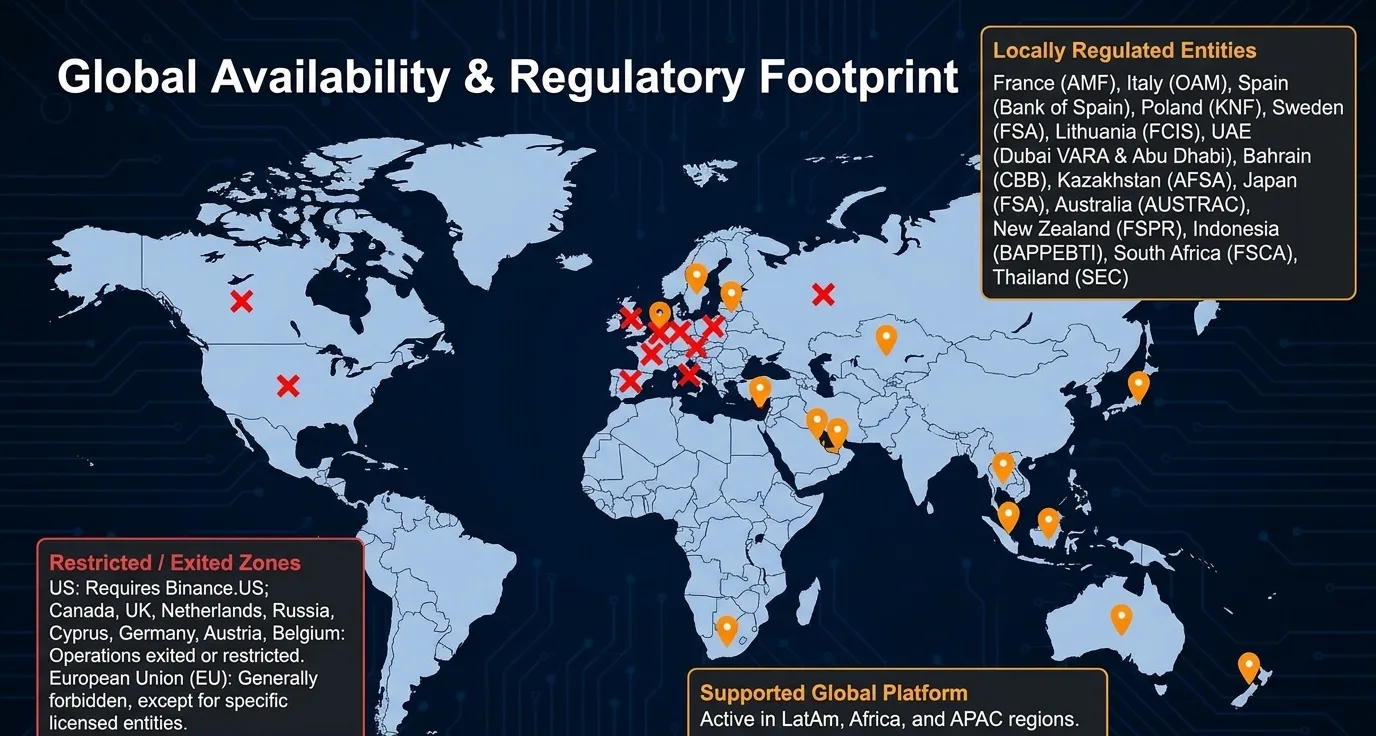
- Locally regulated entities: France (AMF/ACPR), Spain (Bank of Spain), Italy (OAM), UAE (Dubai VARA), Japan (FSA). These jurisdictions have a distinct, locally compliant Binance entity.
- United States: Binance.com is not available. US residents must use Binance.US — a separately incorporated entity with a smaller product set and different fee structure.
- Canada: Fully exited in May 2023 following regulatory pressure from provincial securities commissions.
- United Kingdom: FCA restrictions mean Binance cannot onboard new UK retail clients as of writing.
- Netherlands & Russia: Operations have been fully exited.
- Supported global regions: Latin America, Africa, and APAC remain active, with the broadest product availability.
The competitor matrix: regulated alternatives
For users in restricted markets — or for those who prefer a more traditional regulated environment — several alternatives offer overlapping asset coverage with stronger regulatory frameworks:
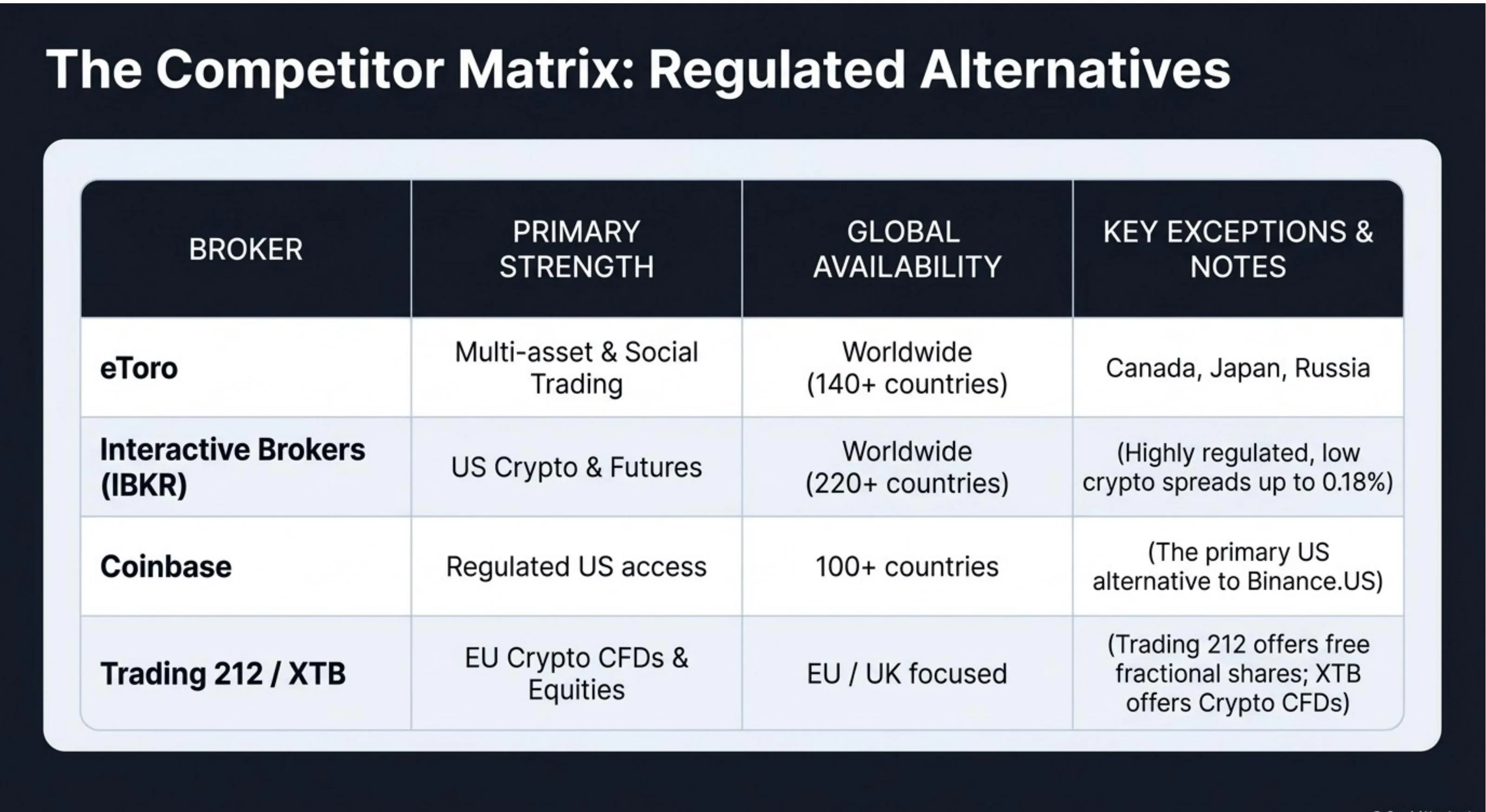
- eToro — Multi-asset and social trading across 140+ countries. Exceptions include Canada, Japan, and Russia. Strong for copy-trading and fractional shares.
- Interactive Brokers (IBKR) — The most geographically broad regulated broker (220+ countries). Offers US crypto and futures with crypto spreads up to 0.18%. Preferred by professional traders who need cross-asset access under one regulated account.
- Coinbase — The primary US-regulated alternative to Binance.US. Available in 100+ countries. Less feature-rich than Binance globally but far more straightforward for US retail access.
- Trading 212 / XTB — EU and UK-focused. Trading 212 offers free fractional shares; XTB offers crypto CFDs. Best for European users who want EU-regulated crypto exposure without a dedicated crypto exchange.
Synthesis: the liquidity flywheel
Binance's fee architecture is not an accident — it's an engineered system designed to create what could be called a "liquidity flywheel." The VIP tier structure, BNB mandate, and ecosystem incentives all work in concert:
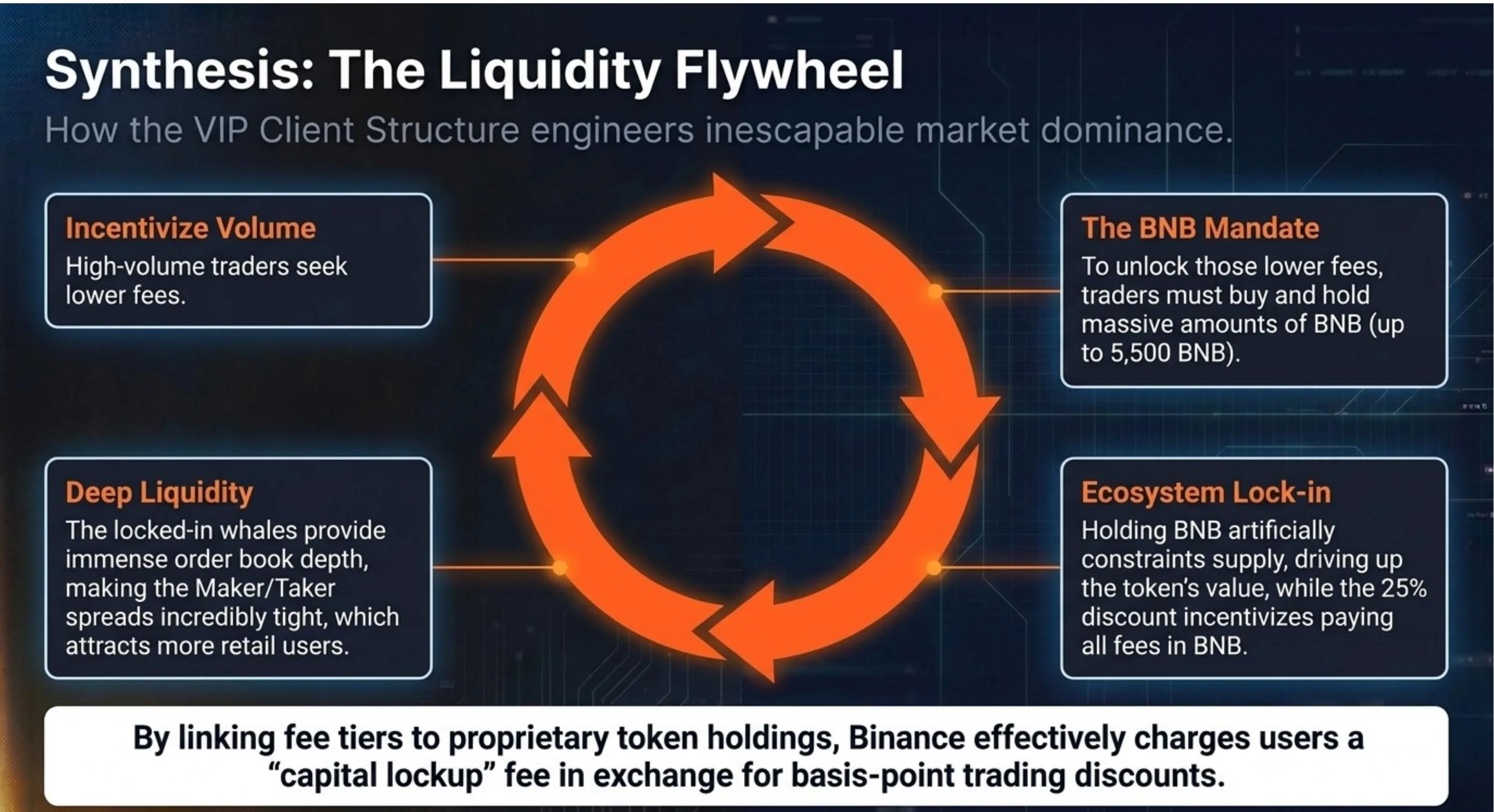
The system is brilliantly designed from Binance's perspective: by requiring BNB holdings for VIP access, Binance effectively collects a "capital lockup" premium — traders lock up capital in BNB in exchange for basis-point discounts on trading fees. The locked BNB constrains supply, supporting its price, which in turn makes the discount seem increasingly valuable. It's a self-reinforcing mechanism.
📈 Who should use Binance — and who shouldn't
The right decision depends entirely on your trading volume, geography, and risk appetite. Here's the diagnostic breakdown: