Saxo Bank is positioned as a premium multi-asset broker — but its fee structure is deliberately tiered to reward capital commitment. Three account tiers (Classic, Platinum, VIP), wildly different carrying costs, regional equity pricing pyramids, and a professional collateral system make Saxo one of the most complex brokers to cost correctly. This is the complete breakdown, updated for Q3 2026.
The account tier architecture
Everything in Saxo Bank's pricing model flows from a single variable: your account tier. The tier you occupy determines your commission rates, your overnight carrying costs, and your access to features like priority routing. Saxo offers three tiers, with an additional Elite designation for very large relationships.
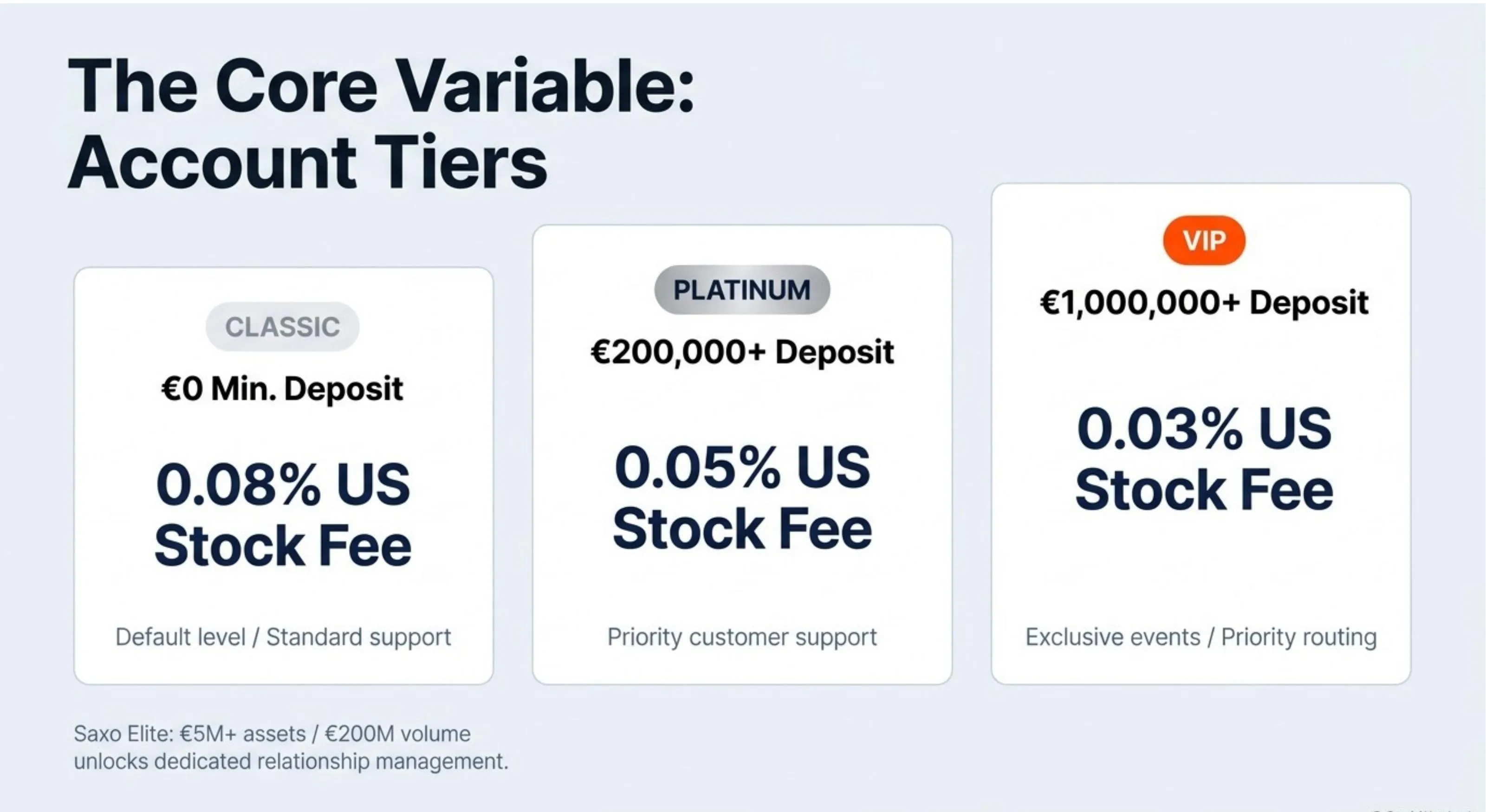
The tier structure determines virtually everything. VIP's 0.03% US stock rate is less than half Classic's 0.08% — a meaningful saving at scale.
- Classic — No minimum deposit. Default commission rates. Standard customer support. The entry point for all retail investors.
- Platinum — Requires €200,000+ deposited. Roughly halves most commission rates. Priority customer support. The threshold where active traders start generating savings.
- VIP — Requires €1,000,000+ deposited. The lowest rates available. Exclusive events, priority routing. Carrying costs drop to 0.5% — 7x cheaper than Classic.
- Saxo Elite — Unlocked at €5M+ assets or €200M+ annual trading volume. Dedicated relationship management. Not a separate pricing tier — sits within VIP rates.
Key takeaway: Saxo's tier system means the same trade on the same asset can cost 62% less for a VIP client than a Classic client. The question for any serious investor is whether the required capital commitment generates enough savings to justify concentrating assets with one broker.
Equities & ETF pricing by region
Saxo charges percentage-based commissions on equities — not flat fees like DEGIRO. The rate varies by tier and exchange region, with a minimum ticket fee enforced in every case. This makes Saxo more cost-efficient than flat-fee brokers on large trades, but more expensive on small ones.
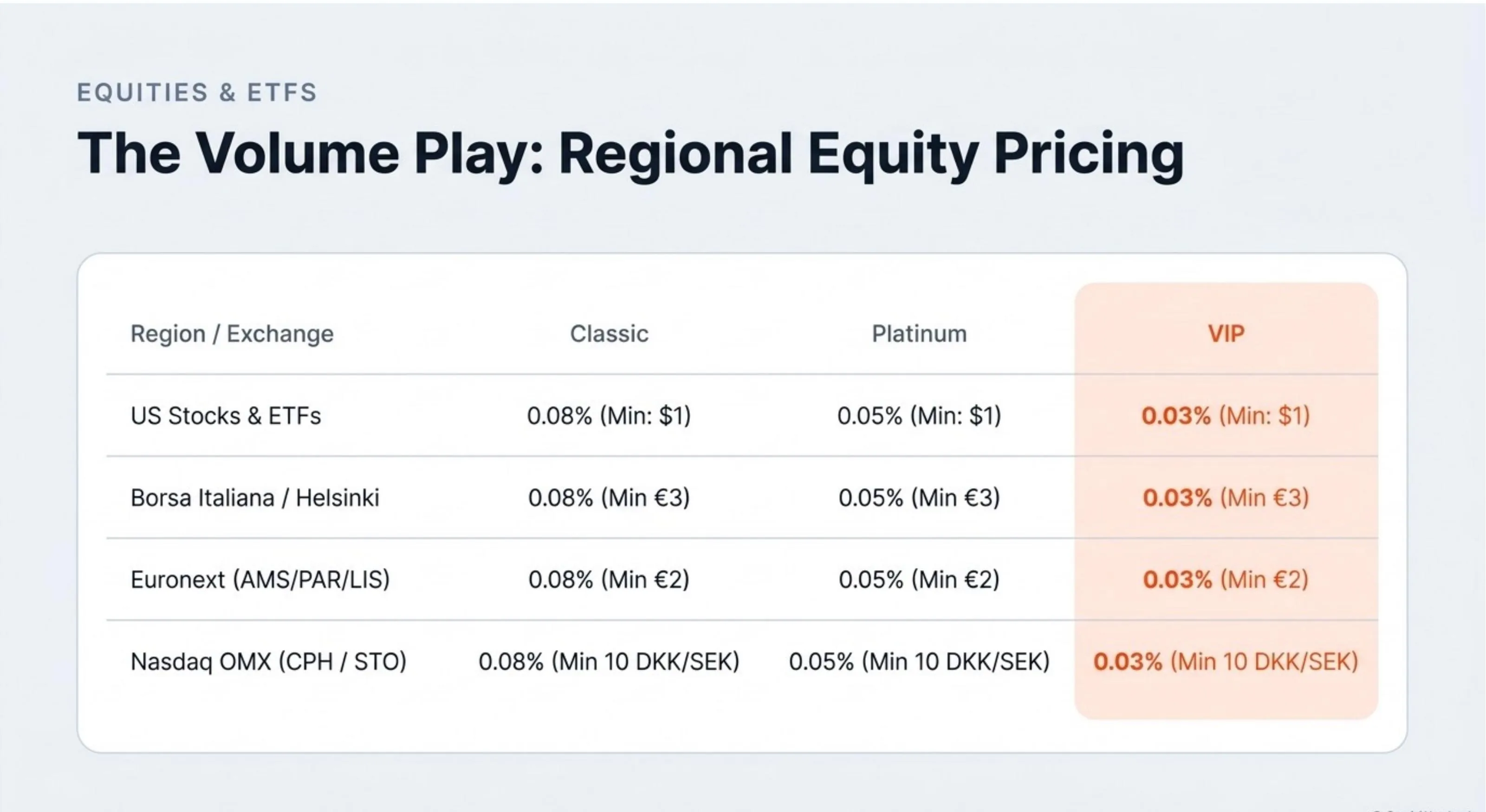
A percentage model with regional minimums. VIP halves the rate vs Classic on every exchange. Minimum tickets mean small trades are disproportionately expensive.
- US Stocks & ETFs: 0.08% (Classic) / 0.05% (Platinum) / 0.03% (VIP) — minimum $1 per trade.
- Euronext (AMS / PAR / LIS): 0.08% / 0.05% / 0.03% — minimum €2 per trade.
- Borsa Italiana & Helsinki: 0.08% / 0.05% / 0.03% — minimum €3 per trade.
- Nasdaq OMX (Copenhagen / Stockholm): 0.08% / 0.05% / 0.03% — minimum 10 DKK/SEK per trade.
Break-even vs. flat-fee brokers: At Classic rates (0.08%, min $1), Saxo costs $1 on a $1,250 trade — the same as a flat-fee broker charging $1. Below $1,250, the minimum ticket makes Saxo more expensive. Above it, the percentage model wins for large trades. At VIP (0.03%), the break-even vs. a €1 flat fee shifts to trades above €3,333.
Fixed income & collateral power
Saxo's bond pricing uses the same tiered percentage model as equities, with a flat minimum of €20 across all tiers — higher than the equity minimums. The more interesting feature is Saxo's bond-as-collateral system for Professional clients, which allows bonds to partially replace cash for margin purposes.
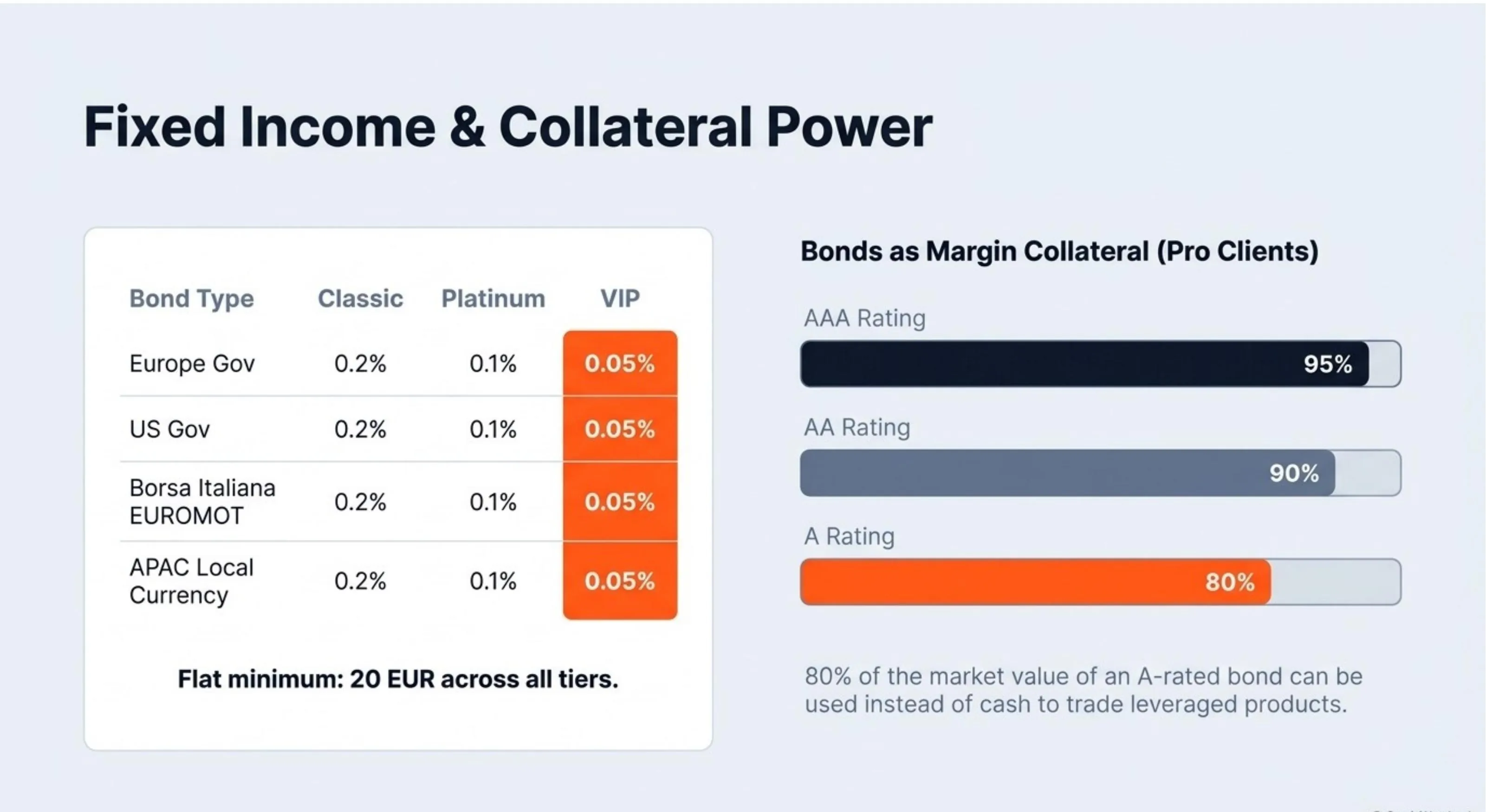
Bond pricing drops by 75% from Classic to VIP. For Professional clients, AAA bonds act as near-cash collateral — freeing capital without liquidating positions.
- Europe Gov / US Gov / Borsa Italiana EUROMOT / APAC Local Currency: Classic 0.20% → Platinum 0.10% → VIP 0.05%. Flat minimum €20 across all tiers.
- Bonds as margin collateral (Professional clients only): AAA-rated 95%, AA-rated 90%, A-rated 80% of market value.
💡
Capital efficiency tip: A Professional client holding €1,000,000 in AAA-rated government bonds can use €950,000 of that as margin collateral. This is a significant advantage over brokers that require pure cash for leverage — you stay invested in fixed income while trading leveraged products simultaneously.
Derivatives: per-contract execution fees
Unlike equities (percentage-based), Saxo charges futures and options using flat per-contract fees — and the tier discount here is dramatic. VIP reduces futures costs to as low as 1 USD for major contracts, versus 3 USD on Classic.
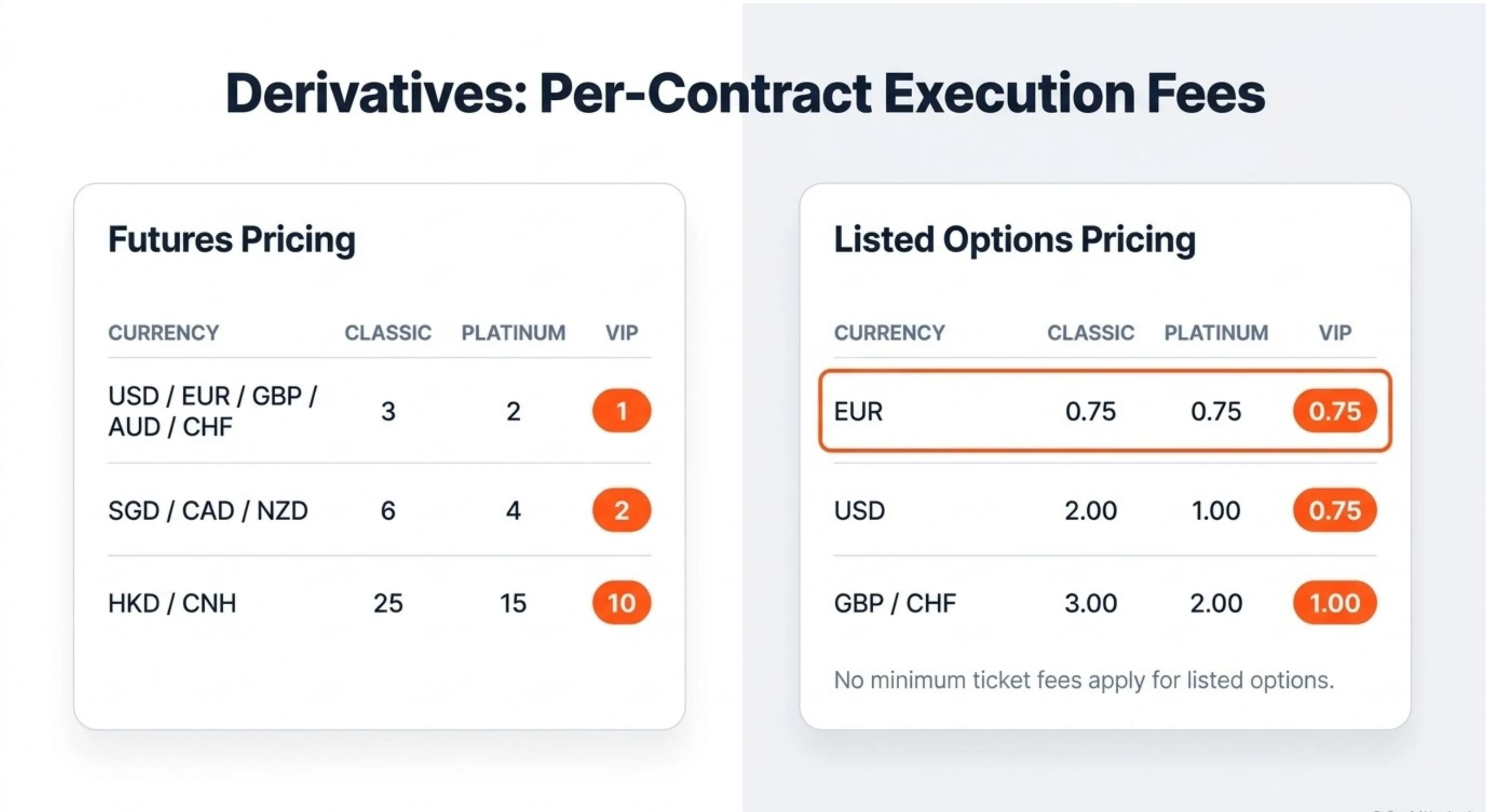
VIP drops major futures to $1/contract — 3x cheaper than Classic. No minimum ticket fees on listed options makes small options trades more viable than on many competing platforms.
- Futures (USD/EUR/GBP/AUD/CHF): Classic 3 → Platinum 2 → VIP 1 per contract.
- Futures (SGD/CAD/NZD): Classic 6 → Platinum 4 → VIP 2 per contract.
- Futures (HKD/CNH): Classic 25 → Platinum 15 → VIP 10 per contract.
- Listed Options (EUR): 0.75 flat across all tiers. No tier discount here.
- Listed Options (USD): Classic 2.00 → Platinum 1.00 → VIP 0.75.
- Listed Options (GBP/CHF): Classic 3.00 → Platinum 2.00 → VIP 1.00.
No minimum ticket on options: Most platforms apply minimum ticket fees that make single-contract options trades uneconomical. Saxo waives this for listed options — allowing precise position sizing regardless of contract count, which is particularly useful for retail options strategies.
Index CFDs & professional custody
Index CFDs on Saxo are priced with flat ticket costs rather than percentages. These are used by professional traders to get leveraged index exposure without futures roll costs. Note the Danish VAT clause — EU-resident individuals pay 25% VAT on certain Saxo fees.
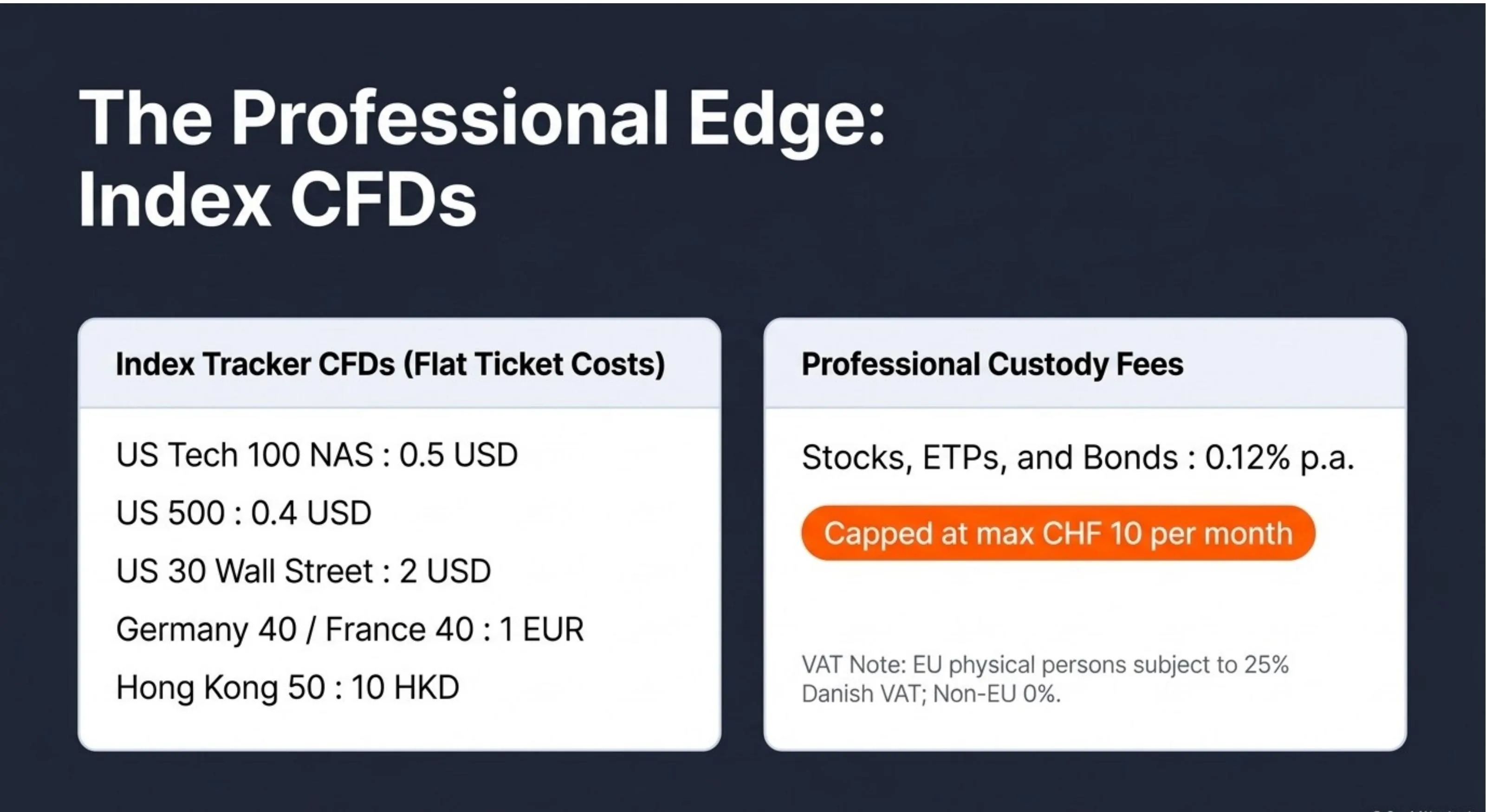
Index CFD ticket costs are near-zero on US indices. The 0.12% p.a. custody fee (max CHF 10/month) is a standing cost on all Saxo holdings — key to factor into your annual cost basis.
- US Tech 100 (NAS): 0.5 USD per ticket.
- US 500: 0.4 USD per ticket.
- US 30 Wall Street: 2 USD per ticket.
- Germany 40 / France 40: 1 EUR per ticket.
- Hong Kong 50: 10 HKD per ticket.
- Professional Custody Fee: 0.12% p.a. on stocks, ETPs, and bonds — capped at CHF 10 per month.
⚠️
VAT note: EU physical persons (individual retail clients resident in the EU) are subject to 25% Danish VAT on certain Saxo fees. Non-EU clients pay 0%. This effectively increases the cost of several fee categories for European retail investors — check Saxo's current fee schedule for which fees are VAT-applicable in your jurisdiction.
The hidden drag: overnight carrying costs
For any investor using leverage — margin loans, CFDs, or leveraged ETPs — overnight carrying costs are the single most significant ongoing expense. Saxo structures these costs as an annual rate applied daily, and the tier differential is enormous.
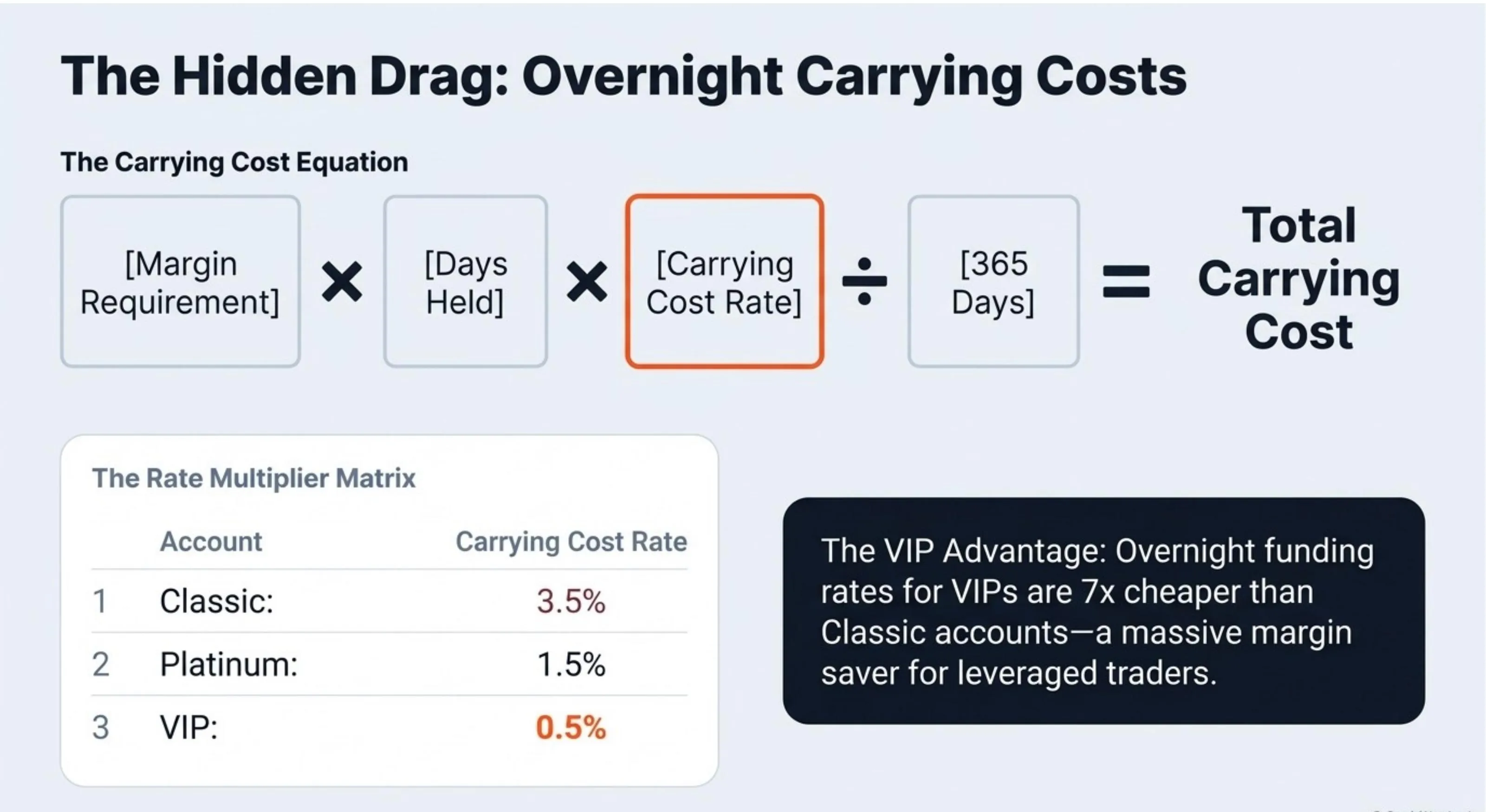
The carrying cost formula is simple but the tier differential is extreme. A leveraged position held for a year costs 7x more on Classic than on VIP.
The formula is: Margin Requirement × Days Held × Carrying Cost Rate ÷ 365 = Daily Carrying Cost.
- Classic: 3.5% annual carrying cost rate.
- Platinum: 1.5% annual carrying cost rate.
- VIP: 0.5% annual carrying cost rate.
⚠️
Carrying cost example: A Classic client borrowing €100,000 on margin for 30 days pays €100,000 × 30 × 0.035 ÷ 365 = €287.67. The same position on VIP costs €100,000 × 30 × 0.005 ÷ 365 = €41.10. For leveraged futures traders who hold positions overnight, this single factor can make or break the profitability of a strategy — and is a strong argument for targeting Platinum (€200k) before committing to leveraged trading on Saxo.
Strategic implication: If you plan to use leverage on Saxo, reaching Platinum tier (€200k) must be part of the plan. Dropping from 3.5% to 1.5% saves 57% on carrying costs alone — a saving that rapidly offsets the capital concentration risk of the Platinum threshold.
Which tier is right for you?
Based on the full pricing architecture, three distinct investor profiles emerge — each with a clear optimal tier recommendation.
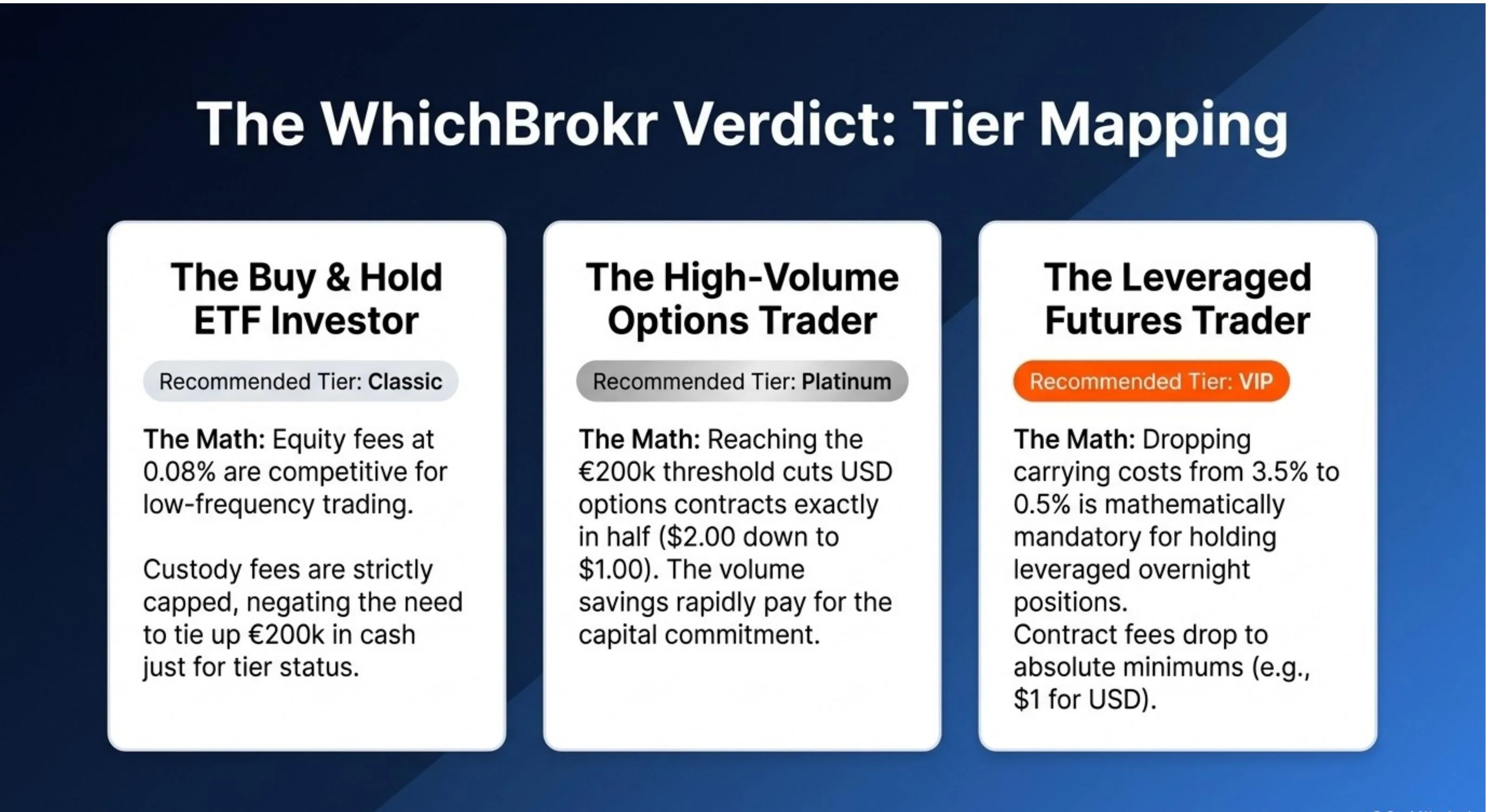
The three Saxo investor archetypes and their optimal tier. Carrying costs — not commissions — drive the tier decision for leveraged traders.
The WhichBrokr verdict
Saxo Bank rewards capital commitment at every level. The tier you target should be determined by your trading strategy — not your deposit size alone.
Classic Tier
The Buy & Hold Investor
0.08% equity fees + capped custody. Competitive for passive, low-frequency investing. No need to chase Platinum if you don't use leverage.
Platinum Tier
The Options Trader
USD options halved to $1.00. Carrying costs drop to 1.5%. €200k threshold savings pay for themselves through volume and leverage cost reduction.
VIP Tier
The Leveraged Futures Trader
0.5% carrying costs are 7x cheaper than Classic. $1 futures. Mathematically required if you hold leveraged positions overnight. Capital efficiency via bond collateral seals it.
Frequently asked questions
Does Saxo Bank charge a monthly fee? +
Saxo charges a custody fee of 0.12% p.a. on the market value of stocks, ETPs, and bonds held, capped at CHF 10 per month. There is no monthly subscription or inactivity fee for most accounts, though EU physical persons may be subject to 25% Danish VAT on certain charges.
What is the difference between Classic, Platinum, and VIP? +
Classic is the default tier with no minimum deposit. Platinum requires €200,000+ and halves most commission rates, plus drops carrying costs from 3.5% to 1.5%. VIP requires €1,000,000+ and offers the lowest rates available — including 0.03% on US equities and 0.5% overnight carrying costs, which are 7x cheaper than Classic.
How are Saxo Bank's overnight carrying costs calculated? +
The formula is: Margin Requirement × Days Held × Carrying Cost Rate ÷ 365. Classic rate is 3.5%, Platinum 1.5%, VIP 0.5%. A €100,000 margin position held for 30 days costs €287.67 on Classic vs €41.10 on VIP — the tier difference alone saves €246 per month on that single position.
Can I use bonds as collateral on Saxo Bank? +
Yes, for Professional clients. AAA-rated bonds count at 95%, AA-rated at 90%, and A-rated at 80% of market value toward margin requirements. This allows you to remain invested in fixed income while simultaneously maintaining leveraged positions — a significant capital efficiency advantage over cash-only collateral systems.
Is Saxo Bank suitable for passive ETF investors? +
Yes, on Classic. The 0.08% rate on US ETFs (min $1) is competitive for larger trades, and the 0.12% p.a. custody fee is capped at CHF 10/month — making the annual custody cost predictable and modest. The platform's complexity and institutional features are overkill for passive investors, but the pricing is reasonable.
What VAT does Saxo Bank charge? +
EU physical persons (retail individual clients based in the EU) are subject to 25% Danish VAT on certain Saxo fees — because Saxo Bank is a Danish bank. Non-EU clients pay 0% VAT. Check Saxo's current fee schedule for the specific fees subject to VAT in your jurisdiction.