Investing is no longer optional. With inflation steadily eroding the purchasing power of money sitting in a bank account, putting your savings to work is a financial necessity — not a luxury reserved for the wealthy. This guide cuts through the noise and gives you a clear, step-by-step framework to start building wealth today.
Step Zero: The Foundation
Before you invest a single euro or dollar, you need two things in place: an income source — a job, a business, a freelance practice — and the discipline to spend less than you earn. No investment strategy in the world can compensate for a negative savings rate. This sounds obvious, but it's the step most people skip.
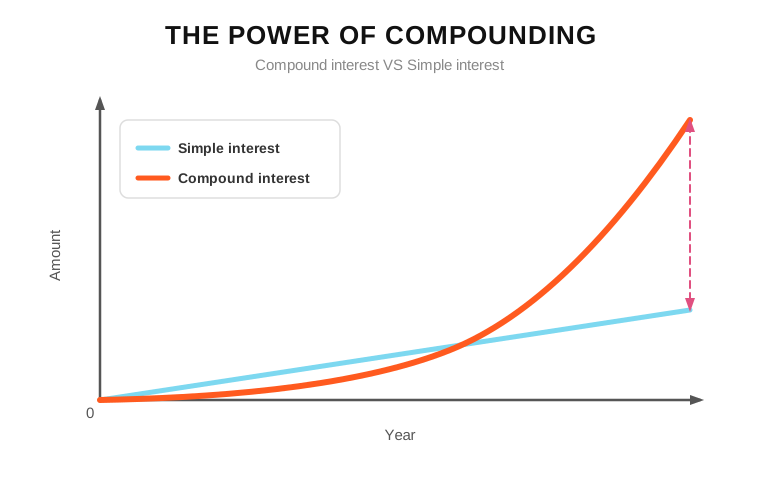
The gap between what you earn and what you spend is your investable surplus. Even a modest surplus, invested consistently over decades, produces transformational results thanks to one of the most powerful forces in finance: compound interest.
Step 1: Build Your Emergency Fund
A cash buffer that covers unexpected expenses and opportunities — kept in a high-yield savings account or money market fund, never invested in volatile assets.
The emergency fund is the most important financial product you will ever have. Its job is not to grow — it's to protect you. Without it, a medical bill, car repair, or job loss forces you to sell investments at the worst possible time.
How much? The minimum is 3 months of your current expenses. Ideally, aim for 6–12 months. The larger your buffer, the more calmly you can ride out market downturns without being forced to sell.
Only once this fund is fully funded should you move to Step 2.
Step 2: Build Your Investment Portfolio
The bulk of your wealth goes into diversified, conservative financial products. A small allocation — 2% to 5% — can go into higher-risk, higher-reward assets.
A well-structured portfolio typically combines several asset classes, each playing a different role:
- Equities (shares/ETFs) — long-term growth engine, highest expected return, highest short-term volatility
- Bonds — income and stability, lower correlation to stocks, acts as a buffer in crashes
- Gold — inflation hedge, tends to hold value when currencies weaken
- Property (REITs or direct) — real asset exposure, income from rents, diversification from financial markets
Reserve 2–5% of your portfolio for more speculative positions: a cryptocurrency position, an emerging theme (AI, biotech, clean energy), or a single stock you believe in. This sleeve lets you participate in high-upside opportunities without risking your core wealth.
Step 3: Invest Regularly — and Let It Compound
Invest a fixed percentage of your income on a regular schedule (monthly, weekly, quarterly) for the next 20–30 years. Choose accumulating ETFs so dividends are reinvested automatically — no annual tax drag.
The single most powerful thing a long-term investor can do is automate regular contributions and stop trying to time the market. By investing the same amount each period regardless of market conditions — a strategy called dollar-cost averaging (DCA) — you automatically buy more shares when prices are low and fewer when prices are high.
Choose accumulating (acc) ETFs rather than distributing (dist) ones. Accumulating ETFs reinvest dividends internally, so you don't receive a taxable distribution each year. Your money compounds fully without the friction of annual tax payments, which makes a significant difference over 20+ years.
💡 The 30-year rule: empirical evidence shows that globally diversified equity portfolios have delivered positive real returns in approximately 95% of all 20-year rolling periods. Time in the market consistently beats timing the market.
The 3 Risks Every Investor Must Manage
When constructing a portfolio, three categories of risk need to be understood and actively managed:
📌 Idiosyncratic Risk Manageable
Risk tied to a specific asset or asset class. A company goes bankrupt. A sector collapses. A single country's economy stagnates.
Solution: diversification. Here's how diversification reduces idiosyncratic risk, from highest to lowest:
- Single stock (e.g. Nvidia) — maximum idiosyncratic risk
- Sector ETF (e.g. S&P 500 Tech) — geographic concentration, sector concentration
- S&P 500 — geographic concentration, sector diversification
- MSCI World — geographic diversification, sector diversification, currency diversification — but still ~65–70% US exposure
- FTSE All-World / ACWI — broader geographic and currency diversification, includes emerging markets
- Multi-asset portfolio (equities + bonds + gold + real estate) — lowest correlation between holdings, lowest idiosyncratic risk — though also lower expected return
⚠️ Common mistake: owning five ETFs that all track the S&P 500 is not diversification — it's the same risk five times over. More ETFs ≠ more diversification. You want ETFs tracking different geographies and asset classes. As Markowitz showed in Modern Portfolio Theory, reducing idiosyncratic risk does not reduce risk-adjusted returns — and risk-adjusted returns are what matter most for long-term investors.
📌 Systematic Risk Time-managed
Risk that affects the entire market — recessions, interest rate cycles, geopolitical crises. You cannot diversify this away because it hits all assets simultaneously.
Solution: time in the market. Empirical evidence points to a minimum holding period of 20 years before systematic risk becomes manageable. Over 20-year periods, globally diversified equity indices have produced positive real returns more than 95% of the time. The longer you stay invested, the less systematic risk matters.
📌 Tail Risk Partially hedged
Rare, extreme, unpredictable events — the Black Swans. Financial crises, pandemics, geopolitical shocks, bank collapses. Nobody can predict these. The 2008 financial crisis, the 2020 COVID crash — these caught almost everyone off guard.
Solution: structural resilience. Split your investments across more than one broker — and if possible, more than one country's financial system. Keep a portion of your wealth in physical assets (gold, property) and a portion in digital platforms. Don't keep everything in one place.
Conclusion: Start Now, Stay the Course
If you follow this framework — build an income, maintain a surplus, fund your emergency reserve, build a diversified portfolio of accumulating ETFs, invest regularly for 30 years — you will be ahead of the vast majority of the world's population in terms of financial resilience.
More importantly, you will be protecting the real value of your money against the inflation that the monetary system structurally produces. Today, investing is not a choice for those who want to build wealth — it's a necessity for anyone who wants to avoid slowly losing it.
Start with your emergency fund. Open an account with a regulated broker. Set up a monthly contribution. And let time do the heavy lifting.
🚀 The best time to start was 20 years ago. The second best time is today. Even small amounts, invested consistently in low-cost index funds, compound into significant wealth over decades. The graph at the top of this page is not a metaphor — it's mathematics.