Interactive Brokers' US pricing is not a single fee schedule — it is a structural decision tree. Which account tier you choose, which pricing plan you select, and how large your portfolio grows each unlocks a completely different cost profile. Most US investors only ever see the surface. This guide decodes every layer: the Lite vs Pro split, Fixed vs Tiered execution, the cash yield staircase, margin leverage tiers, hidden fees, and the final synthesis of which structure wins for each trader type.
A structural diagnostic of Interactive Brokers US pricing — account types, execution costs, and capital efficiency across the full fee architecture.
The foundational split: IBKR Lite vs IBKR Pro
Every Interactive Brokers US account begins with the same first decision: Lite or Pro. This is not a minor preference — it is a structural choice that determines your commission rate, your cash yield, your margin cost, and your order execution quality across every trade you ever place.
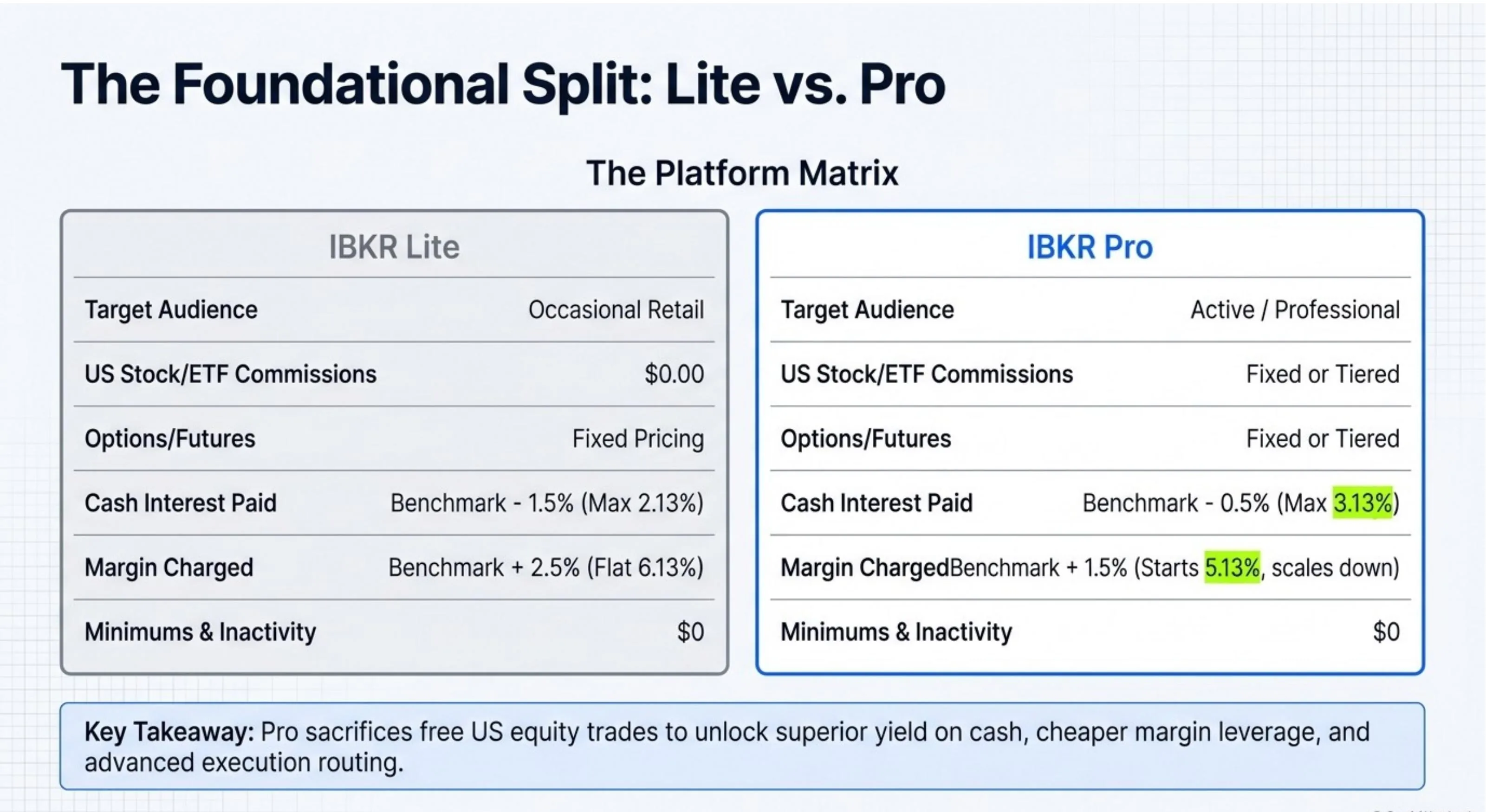
The platform matrix: IBKR Lite sacrifices cash yield and cheaper margin to deliver $0 equity commissions. Pro pays a visible commission but unlocks superior yield, cheaper leverage, and SmartRouting execution.
| Feature |
IBKR Lite |
IBKR Pro |
| Target audience |
Occasional retail |
Active / professional |
| US stock/ETF commissions |
$0.00 |
Fixed or Tiered (see below) |
| Options & Futures |
Fixed pricing only |
Fixed or Tiered |
| Cash interest paid |
Benchmark − 1.5% (max ~2.13%) |
Benchmark − 0.5% (max ~3.13%) |
| Margin charged |
Benchmark + 2.5% (flat 6.13%) |
Benchmark + 1.5% → scales to +0.5% |
| Order routing |
Payment for Order Flow (PFOF) |
IB SmartRouting — best execution |
| Minimums & inactivity |
$0 |
$0 |
The core trade-off: Pro sacrifices free US equity commissions to unlock superior cash yield on uninvested balances, cheaper margin leverage at scale, and SmartRouting execution that frequently achieves Price Improvement exceeding the commission cost. For active investors, Pro's total cost of ownership is almost always lower.
The execution engine: Fixed vs Tiered pricing on IBKR Pro
If you choose IBKR Pro, you face a second decision: Fixed or Tiered. This shapes the economics of every order. The answer depends almost entirely on your trade frequency and typical order size.
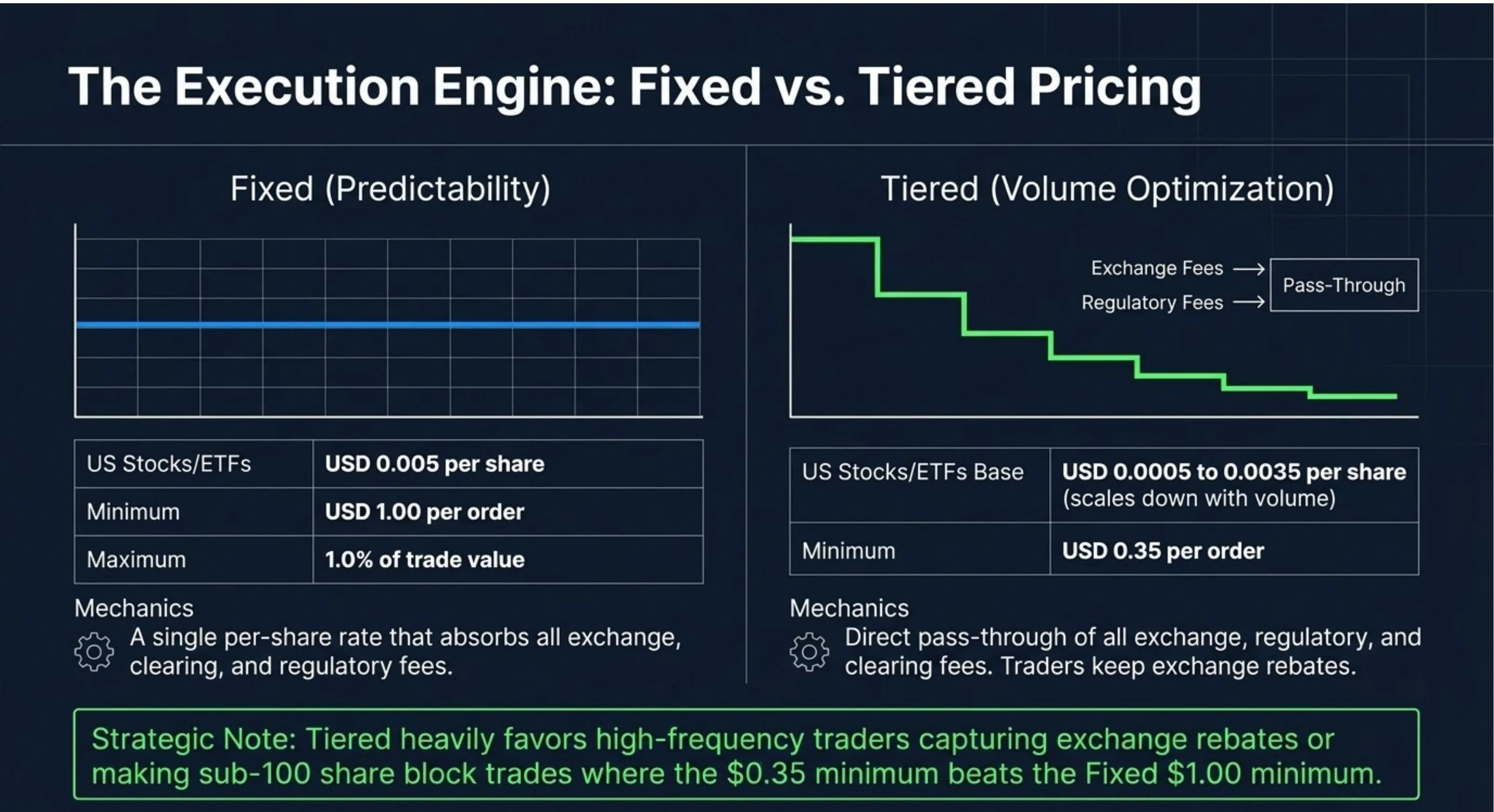
Fixed gives predictable per-share pricing absorbing all exchange fees. Tiered passes all exchange and regulatory fees through directly — and passes exchange rebates back to you, rewarding liquidity provision at volume.
| Parameter |
Fixed |
Tiered |
| US Stocks/ETFs (per share) |
$0.005 |
$0.0005 – $0.0035 |
| Minimum per order |
$1.00 |
$0.35 |
| Maximum per order |
1% of trade value |
1% of trade value |
| Exchange & regulatory fees |
Absorbed in rate |
Passed through directly |
| Exchange rebates |
Not passed through |
Passed directly to client |
| Best for |
Low-to-medium volume, predictability |
High volume, block trades <100 shares, algo traders |
⚡
The $0.35 vs $1.00 threshold: Tiered's $0.35 minimum per order is the key advantage for small-lot traders. A 50-share block trade costs $0.35 on Tiered vs $1.00 on Fixed. At 100+ trades/month of sub-100-share lots, Tiered can halve your commission bill — before exchange rebates are even counted.
Asset class baselines: what IBKR Pro charges across every instrument
Beyond US equities, IBKR Pro covers every major tradable asset class accessible to US investors. Here is the complete pricing schedule:
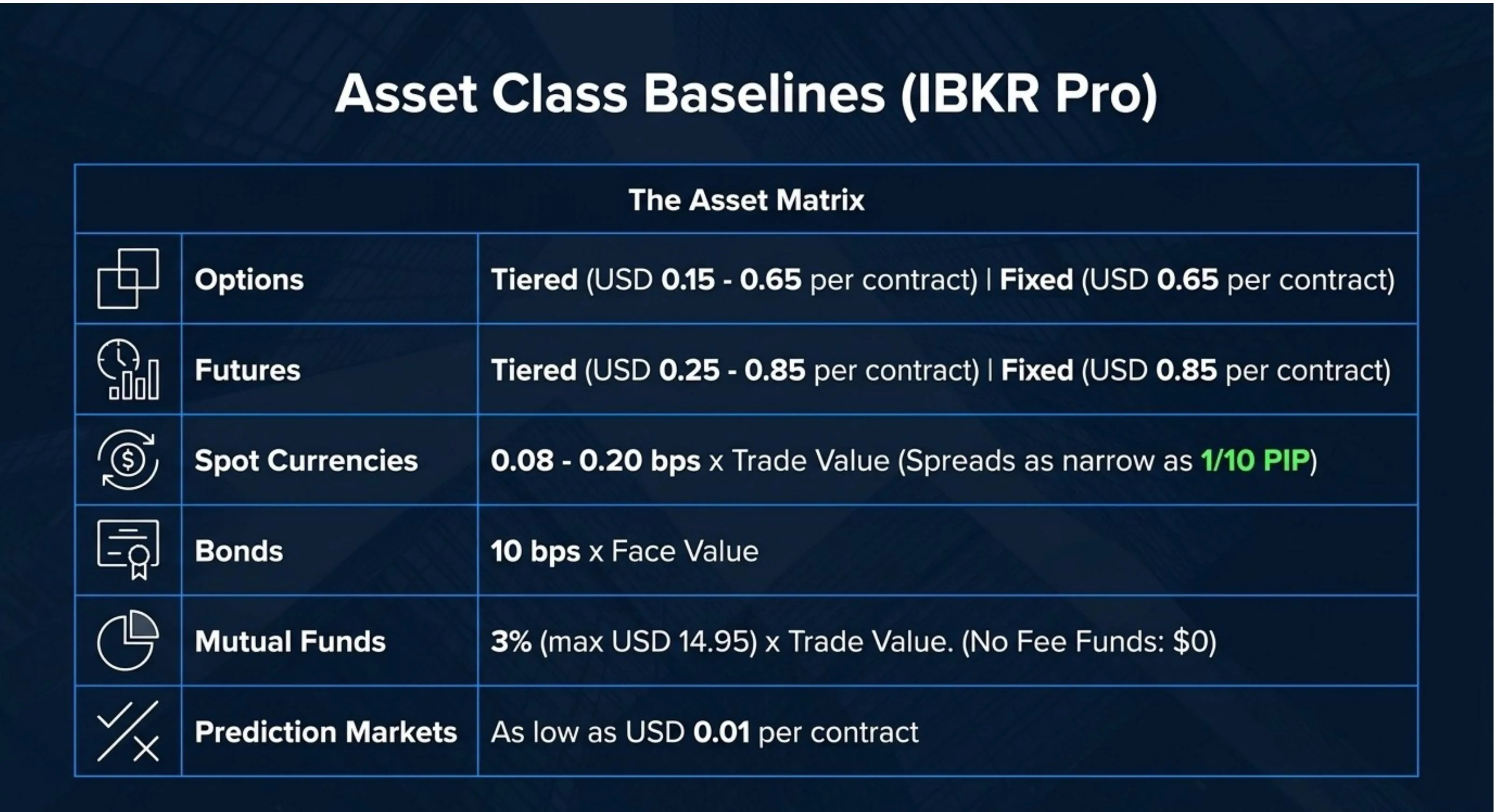
The complete IBKR Pro asset matrix for US investors. Spot currencies trade at spreads as narrow as 1/10 PIP. Prediction Markets — unique to IBKR among major US brokers — start from $0.01 per contract.
| Asset Class |
Tiered |
Fixed |
Notes |
| US Stocks & ETFs |
$0.0005–$0.0035/share |
$0.005/share |
Min $0.35 / $1.00; max 1% |
| Options |
$0.15–$0.65/contract |
$0.65/contract |
— |
| Futures |
$0.25–$0.85/contract |
$0.85/contract |
— |
| Spot Currencies (FX) |
0.08–0.20 bps × trade value |
Spreads as narrow as 1/10 PIP |
| Bonds |
10 bps × face value |
— |
| Mutual Funds |
3% (max $14.95) |
No-Fee Funds: $0 |
| Prediction Markets |
From $0.01/contract |
Unique IBKR offering |
The mechanics of yield: how IBKR pays interest on uninvested cash
One of IBKR Pro's most underappreciated features is the interest paid on uninvested USD cash. The headline rate of ~3.13% tells only part of the story — the effective rate you actually earn depends on a three-zone staircase tied to your total portfolio NAV.
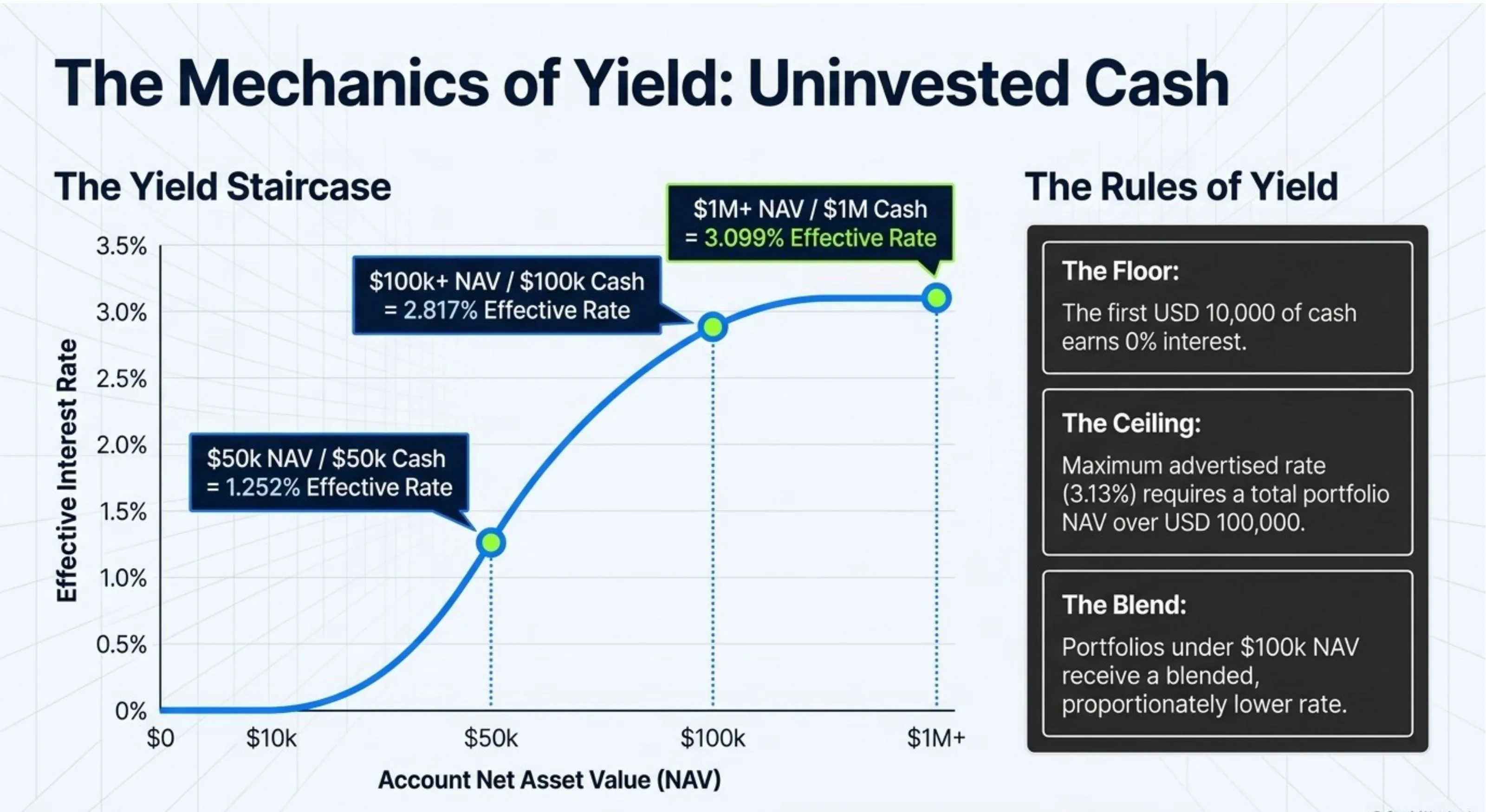
The yield staircase: effective interest rate scales with your total portfolio NAV. Only the portion of cash above $10,000 earns interest — and only accounts above $100,000 NAV earn the full Benchmark minus 0.5% rate.
0%
First $10,000 cash (the floor)
1.25%
Effective rate at $50k NAV / $50k cash
2.82%
Effective rate at $100k NAV / $100k cash
3.10%
Effective rate at $1M+ NAV / $1M cash
⚠️
The $10k floor: The first $10,000 of cash in your account earns zero interest. Only the balance above this threshold accrues yield. Portfolios under $100,000 NAV receive a blended, proportionately lower rate — not the full Benchmark minus 0.5%. The 3.13% headline rate requires more than $100,000 total account value.
Cash yield reality check: IBKR vs Bank of America, Citi, E*Trade, Schwab
The cash yield advantage only materialises above a certain account size. At small balances, IBKR's $10k floor actually makes it the worst-paying option. At meaningful balances, it is not even a close race.
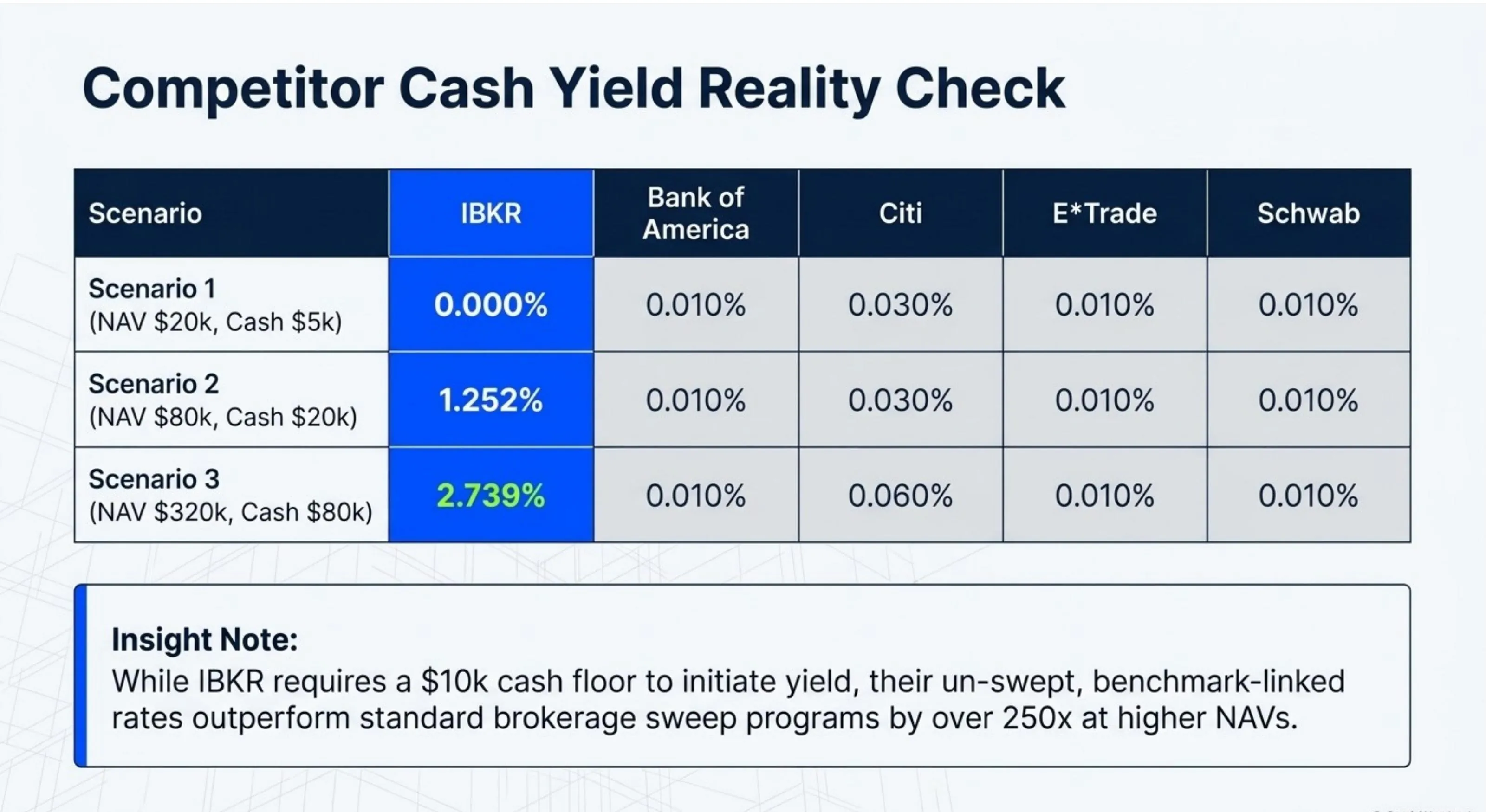
At $80k NAV IBKR pays 1.252% vs Schwab's 0.010% — a 125× difference. At $320k NAV the gap widens to 2.739% vs 0.060% — over 45× more yield than Citi's highest sweep program. The benchmark-linked structure scales in a way no sweep account can match.
The inflection point: Below $20k NAV and $10k cash, IBKR pays literally nothing while Bank of America pays 0.010%. Above $80k NAV, IBKR's benchmark-linked rate outperforms standard brokerage sweep programs by over 125×. The cash yield alone can justify the switch for investors with six-figure accounts.
Margin leverage architecture: the four-tier staircase
IBKR Pro's margin rates use a blended tier waterfall that becomes dramatically cheaper as loan size grows. IBKR Lite, by contrast, charges a flat 6.13% (Benchmark + 2.5%) regardless of loan size — a penalty that compounds significantly on larger positions.
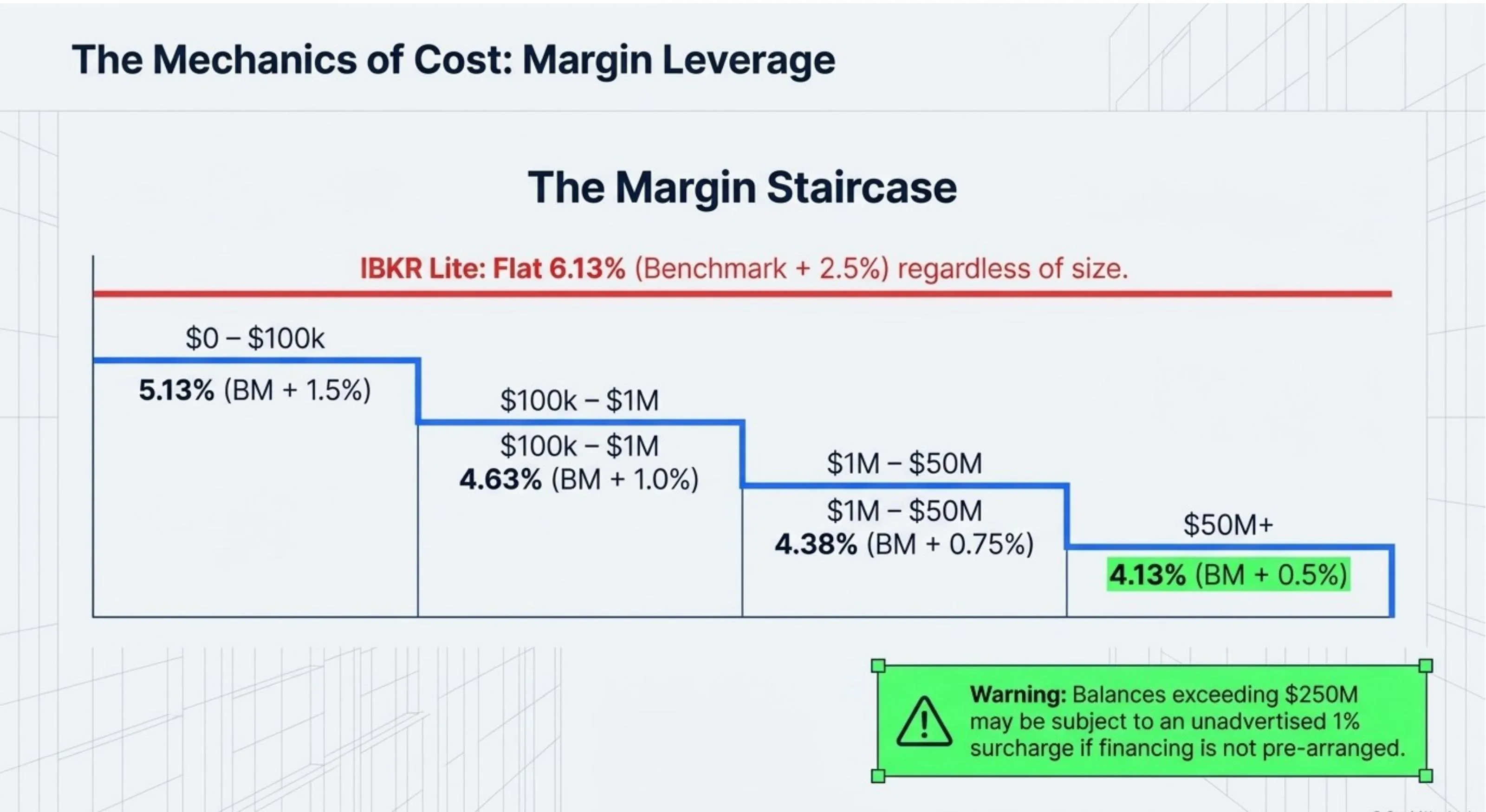
The margin staircase. IBKR Lite pays a flat 6.13% — 1% more than Pro's starting rate and nearly 2% more than Pro's $50M+ tier. Each successive Pro tranche drops the spread, making leverage materially cheaper at scale.
| Loan Size |
IBKR Lite Rate |
IBKR Pro Rate |
Spread over Benchmark |
| Any balance |
6.13% (flat) |
— |
BM + 2.5% (Lite) |
| $0 – $100,000 |
6.13% |
5.13% |
BM + 1.5% |
| $100,000 – $1,000,000 |
6.13% |
4.63% |
BM + 1.0% |
| $1,000,000 – $50,000,000 |
6.13% |
4.38% |
BM + 0.75% |
| $50,000,000+ |
6.13% |
4.13% |
BM + 0.5% |
⚠️
Large balance warning: Margin balances exceeding $250 million may be subject to an unadvertised 1% surcharge if financing has not been pre-arranged with IBKR's treasury desk. Institutional clients approaching this threshold should confirm financing terms in advance.
The hidden ledger: non-commission fees most investors miss
The commission schedule is only part of what IBKR charges. A second layer of fees operates below the surface — triggered by specific transfer types, corporate actions, or institutional reporting requirements. Most retail investors will never encounter these, but knowing they exist prevents surprises.
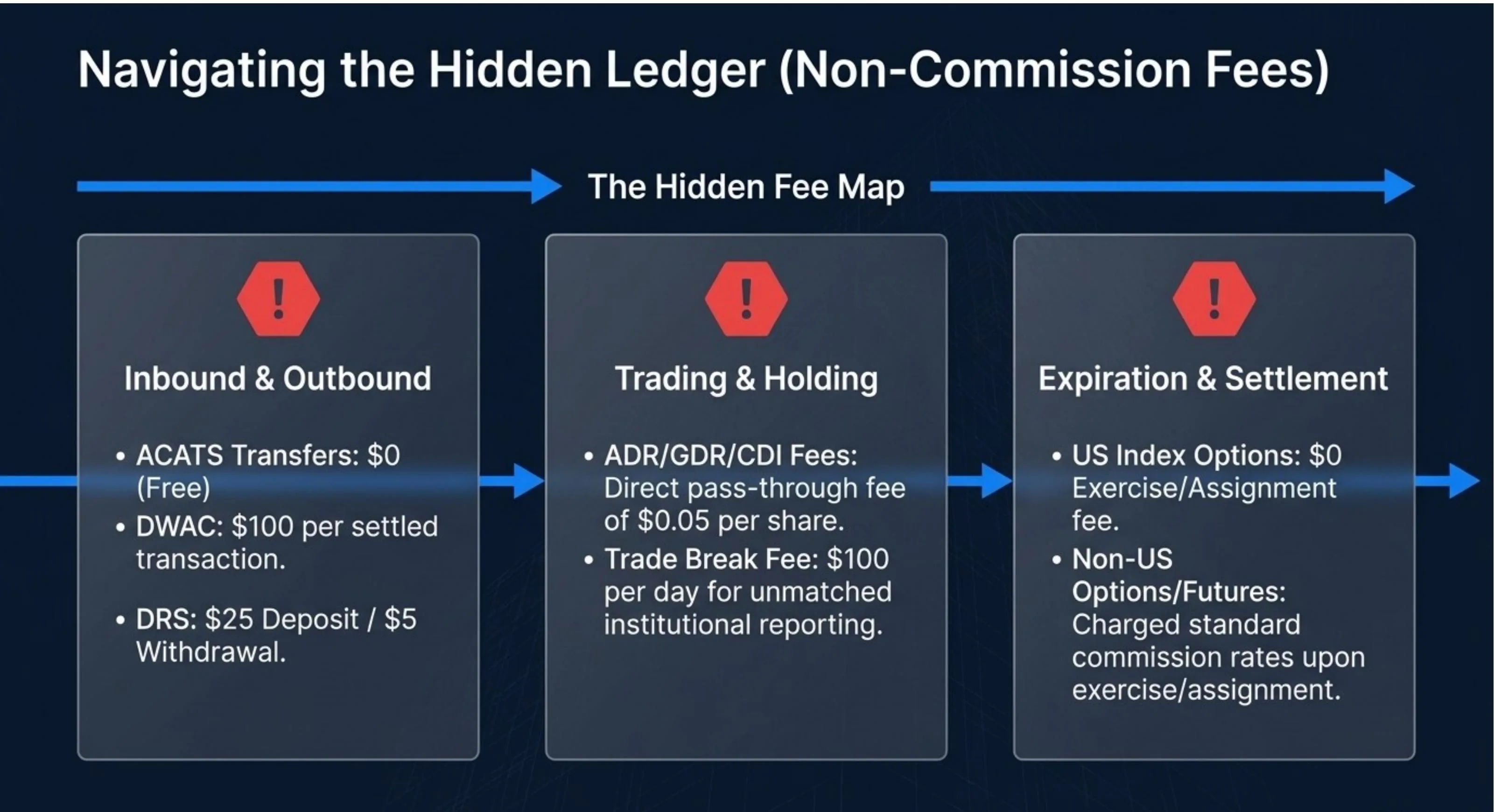
The three categories of non-commission fees. ACATS electronic transfers are free. DWAC and DRS physical certificate services carry meaningful charges. ADR depository fees are industry-standard pass-throughs — not unique to IBKR.
| Category |
Fee Item |
Cost |
| Inbound transfers |
ACATS electronic transfer in |
$0 — Free |
| Transfers |
DWAC (physical certificate delivery) |
$100 per settled transaction |
| Transfers |
DRS (Direct Registration System) |
$25 deposit / $5 withdrawal |
| Trading & Holding |
ADR / GDR / CDI depository fees |
$0.05 per share (pass-through) |
| Institutional |
Trade break fee (unmatched reporting) |
$100 per day |
| Exercise & Assignment |
US Index Options exercise/assignment |
$0 |
| Exercise & Assignment |
Non-US Options / Futures |
Standard commission rates |
Institutional architectures and minimum requirements
IBKR's US platform serves three institutional tiers beyond standard retail accounts, each with its own minimum commitment structure and fee regime.
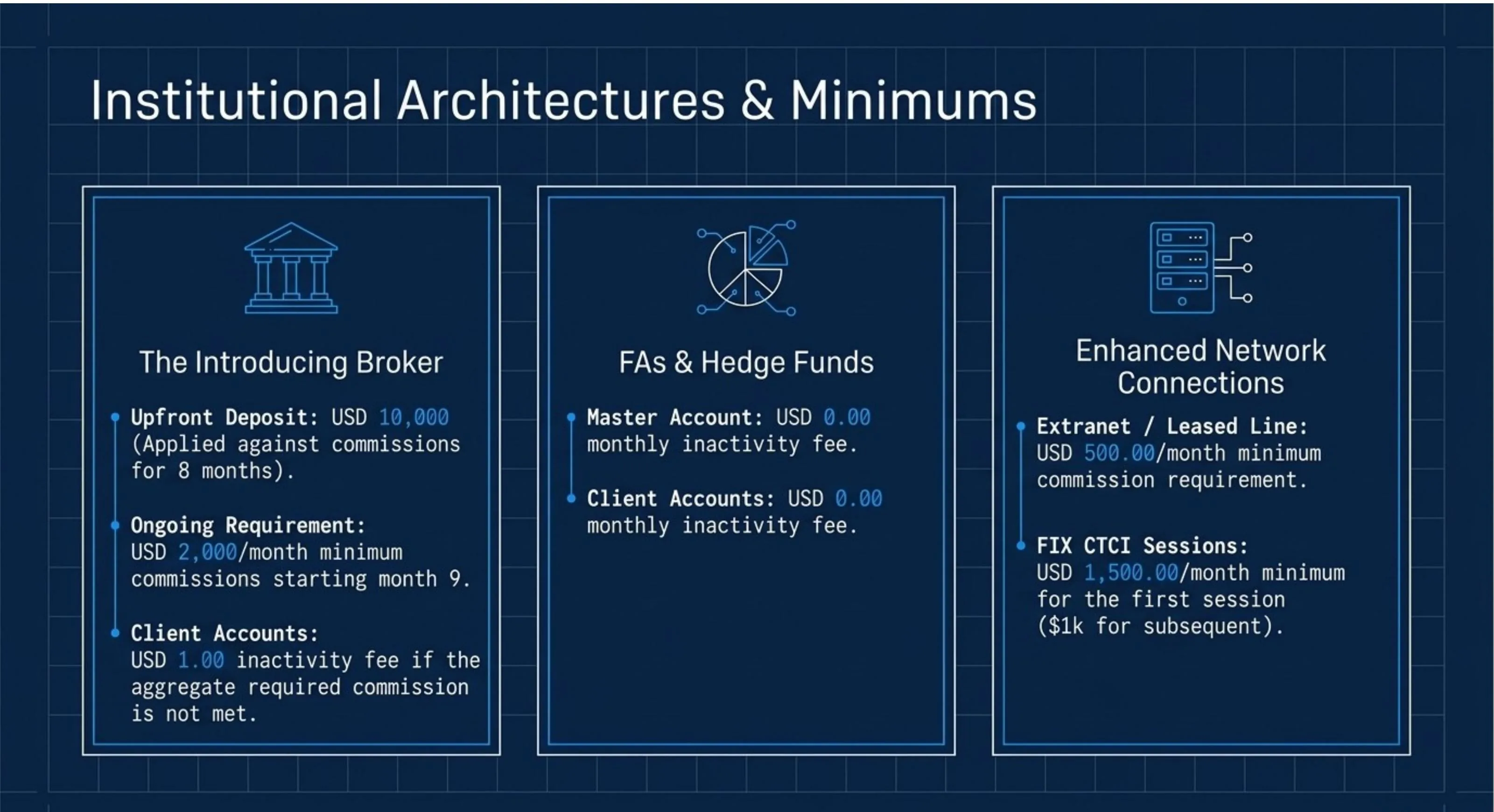
Institutional pricing structures. The Introducing Broker's $10k upfront is applied against commissions over 8 months — effectively a credit. FA and Hedge Fund master accounts carry zero inactivity fees. Enhanced connectivity fees apply to co-location and algorithmic trading infrastructure.
Synthesis: which IBKR structure wins for your profile
The correct choice is not about finding the lowest single fee — it is about matching your trading behaviour to the structural ledger that minimises your total cost of ownership across commissions, yield foregone, margin paid, and execution slippage.
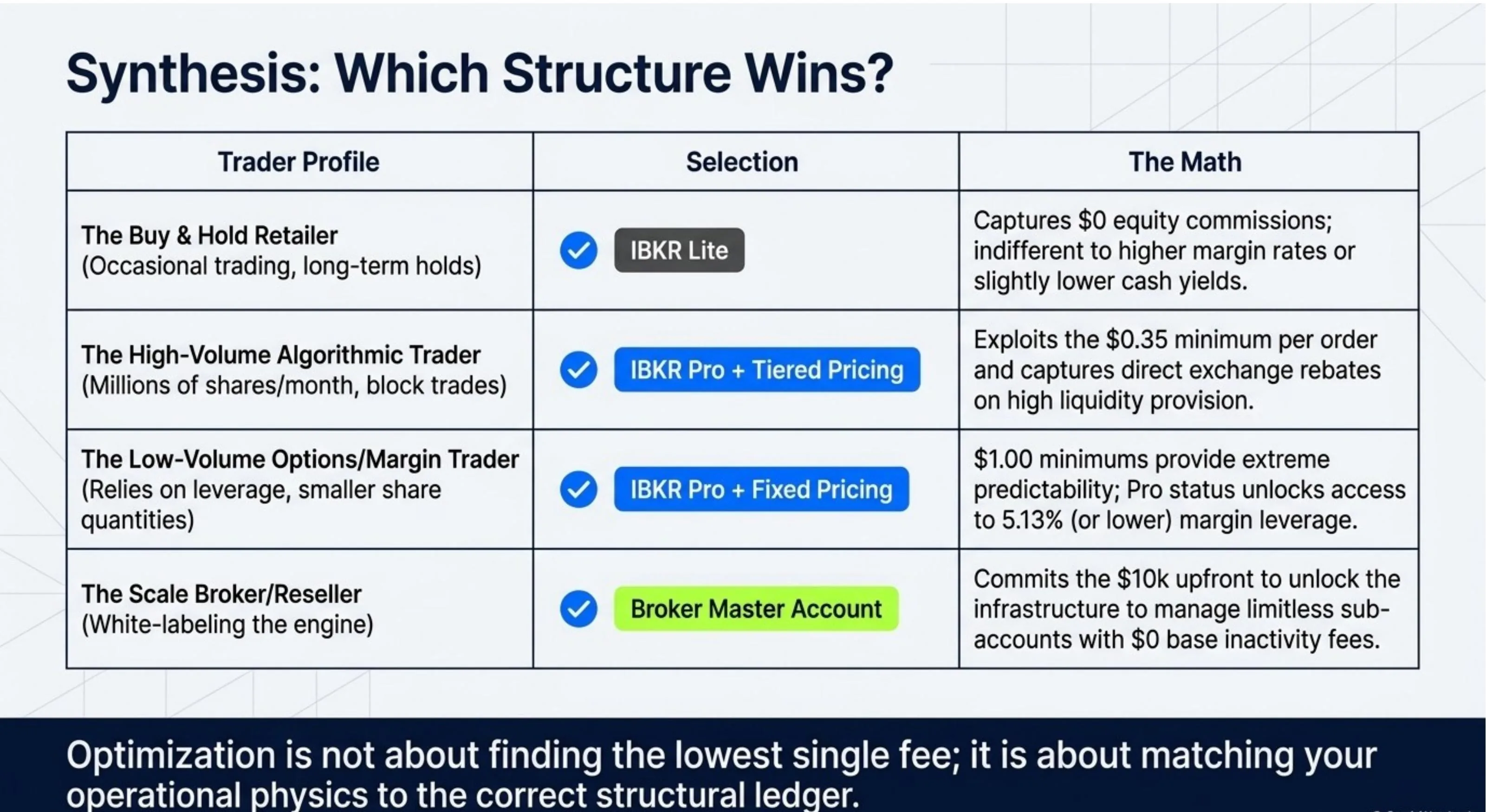
The four structural profiles: each maps to a different IBKR configuration. Optimization is not about the lowest single fee — it is about matching your operational model to the correct structural ledger.
The WhichBrokr verdict on IBKR US pricing
IBKR's pricing is the most structurally sophisticated in the US retail market. Every layer rewards investors who understand and activate it correctly.
Lite · Buy & Hold
The Casual Retailer
$0 US equity commissions. Indifferent to higher margin rates or slightly lower cash yield. Best for occasional investors who rarely use leverage.
Pro + Tiered · Algo
The High-Volume Trader
$0.35 order minimum + exchange rebates. Tiered rates drop as low as $0.0005/share at volume. Sub-100-share block trades dramatically cheaper than Fixed.
Pro + Fixed · Options
The Options/Margin Trader
$1.00 minimum provides cost predictability. Pro status unlocks margin from 5.13% — vs Lite's flat 6.13%. Critical for leveraged strategies where basis points matter.
Master Account · B2B
The Scale Broker
$10k upfront (applied as commissions over 8 months) unlocks unlimited sub-accounts at $0 base inactivity fees. The white-label infrastructure play.
"Optimization is not about finding the lowest single fee; it is about matching your operational physics to the correct structural ledger."
Frequently asked questions
What is the difference between IBKR Lite and IBKR Pro? +
IBKR Lite offers $0 commissions on US stocks and ETFs but routes via Payment for Order Flow, charges a flat 6.13% margin rate, and pays Benchmark minus 1.5% on cash (max ~2.13%). IBKR Pro charges commissions but uses SmartRouting for best execution, offers tiered margin starting at 5.13% scaling to 4.13%, and pays Benchmark minus 0.5% on cash — nearly 3x better yield at scale.
Fixed or Tiered pricing — which should I choose on IBKR Pro? +
Choose Fixed ($0.005/share, min $1.00) if you trade low-to-medium volume and value predictability. Choose Tiered ($0.0005–$0.0035/share, min $0.35) if you place high-frequency orders or sub-100-share block trades — the $0.35 minimum undercuts Fixed's $1.00, and exchange rebates at volume further reduce net cost. You can switch plans in the Client Portal.
Does Interactive Brokers pay interest on uninvested cash? +
Yes, on IBKR Pro. The first $10,000 earns 0% (the floor). Above $10,000, you earn Benchmark minus 0.5% — but the effective rate scales with portfolio NAV. At $50k NAV: ~1.25%. At $100k NAV: ~2.82%. At $1M+ NAV: ~3.10%. IBKR Lite pays Benchmark minus 1.5%, capped at ~2.13%. Balances below $100k NAV receive a blended, proportionately lower rate.
What are the IBKR Pro margin rates? +
IBKR Pro uses a blended tier waterfall: $0–$100k at 5.13% (BM+1.5%), $100k–$1M at 4.63% (BM+1.0%), $1M–$50M at 4.38% (BM+0.75%), and $50M+ at 4.13% (BM+0.5%). IBKR Lite is a flat 6.13% regardless of size. Note: balances above $250M may face an unadvertised 1% surcharge if financing is not pre-arranged.
Are ACATS transfers free at Interactive Brokers? +
Yes — ACATS electronic transfers in are free. DWAC (physical certificate delivery) costs $100 per settled transaction. DRS (Direct Registration System) costs $25 to deposit and $5 to withdraw. ADR/GDR/CDI depository fees of $0.05/share are industry-standard pass-throughs — not a markup by IBKR.