AvaTrade advertises 0% commission on stocks, crypto and forex — and that headline is technically true. But AvaTrade is a market maker, and its revenue comes from places you don't see on the order ticket: spreads, a ~0.5% currency conversion markup, a daily overnight premium on every held position, and one of the steepest inactivity regimes in the industry. This is the full breakdown of what trading at AvaTrade really costs, and how protection changes depending on which regulated entity you end up with.
AvaTrade at a glance
Before looking at individual fees, it helps to understand what kind of broker AvaTrade is. It is a CFD and forex specialist founded in 2006 and headquartered in Dublin, operating through a group of regulated entities on several continents.
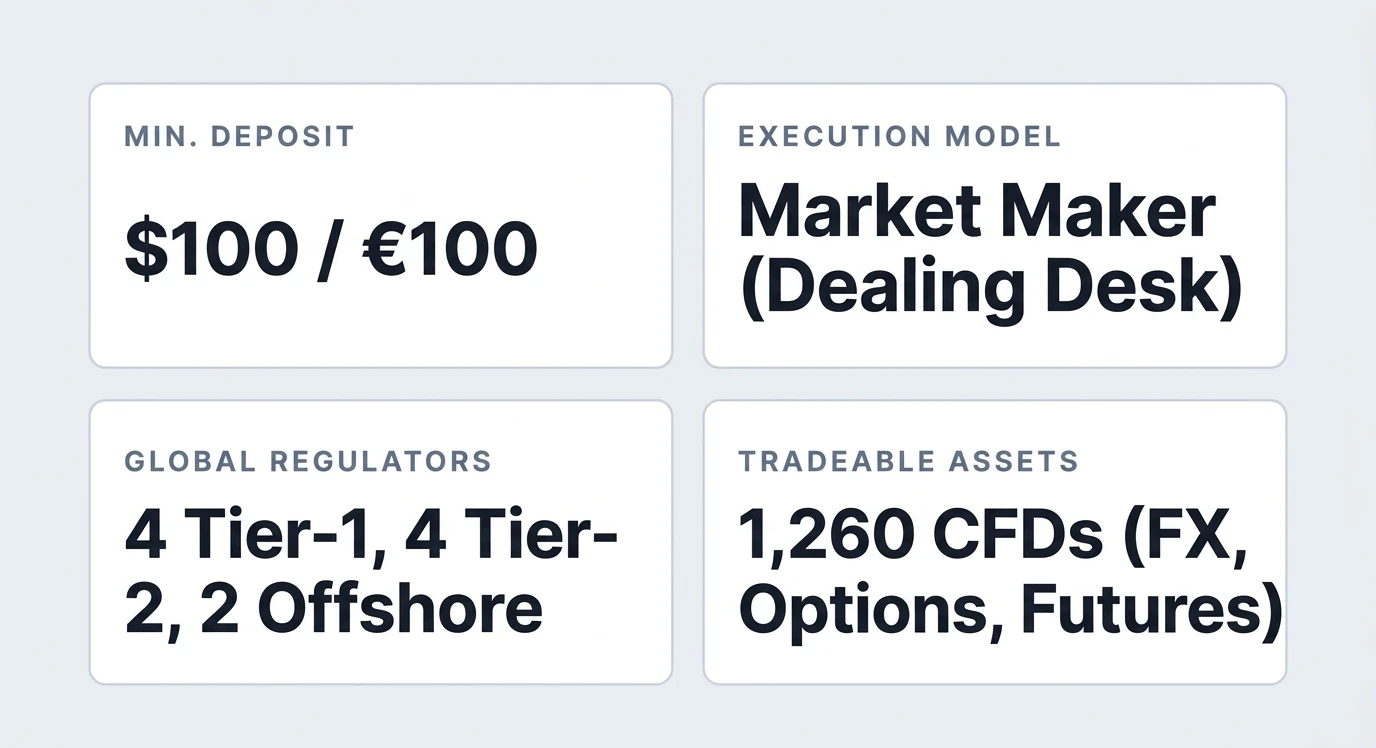
- Minimum deposit: $100 / €100 (or 100 units of your account's base currency).
- Execution model: market maker with its own dealing desk — AvaTrade is the counterparty to your trades.
- Regulation: Central Bank of Ireland, CySEC, ASIC and Japan FSA (Tier-1); FSCA, ADGM FSRA, ISA and Kenya CMA (Tier-2); BVI FSC (offshore).
- Products: roughly 1,260 CFDs (forex, stocks, ETFs, indices, commodities, crypto, bonds), plus FX vanilla options and exchange-traded futures.
The advertisement vs. the engine
The marketing message is simple: 0% commission on stocks and crypto. The engine underneath is a market maker. AvaTrade quotes its own bid and ask prices and acts as your direct counterparty — there is no Direct Market Access (DMA), no ECN and no STP account.
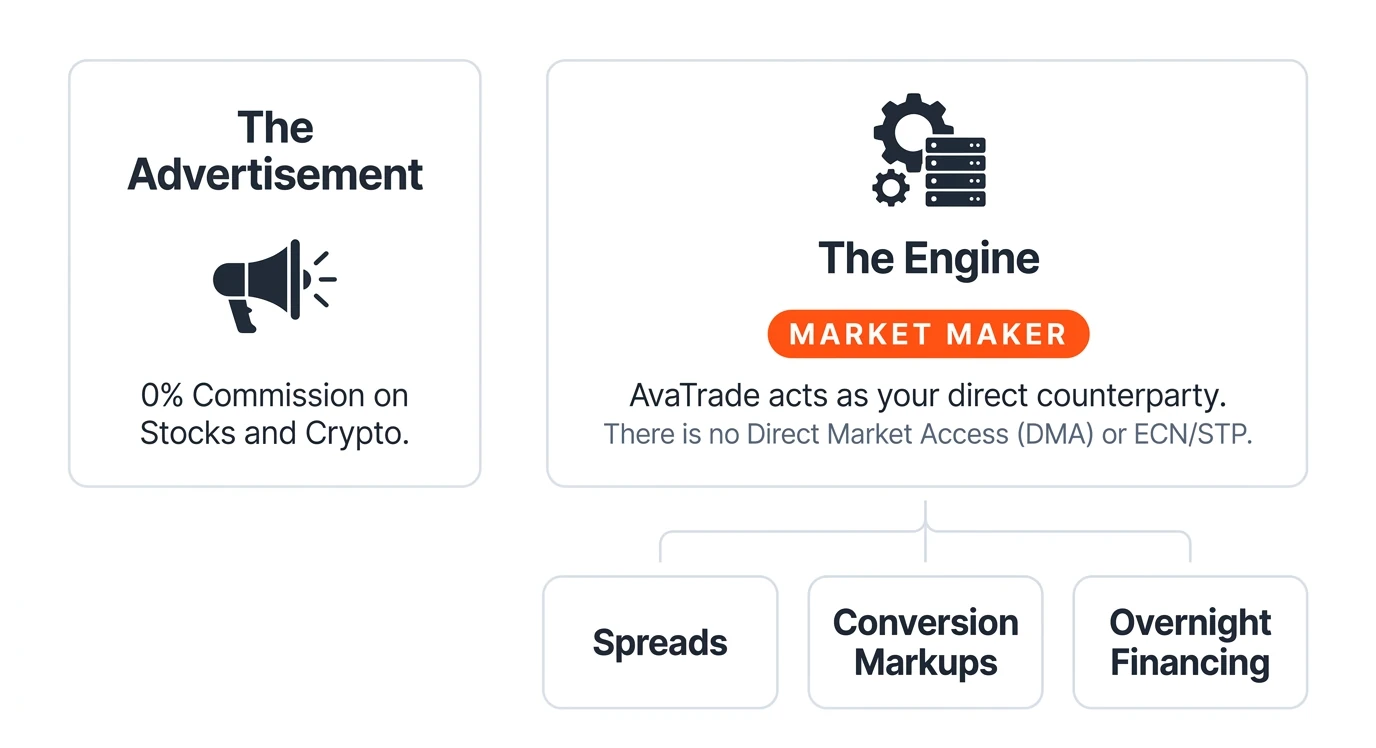
That leaves three revenue channels you need to price in:
- Spreads — the gap between buy and sell prices, built into every quote.
- Conversion markups — charged whenever money or P&L crosses currencies.
- Overnight financing — a daily premium on every leveraged CFD position you hold past the cut-off.
The cost iceberg: visible vs. hidden fees
The costs you see on the trading screen are only the tip. The fees that do the real damage over time sit below the waterline and rarely appear on a trade confirmation.
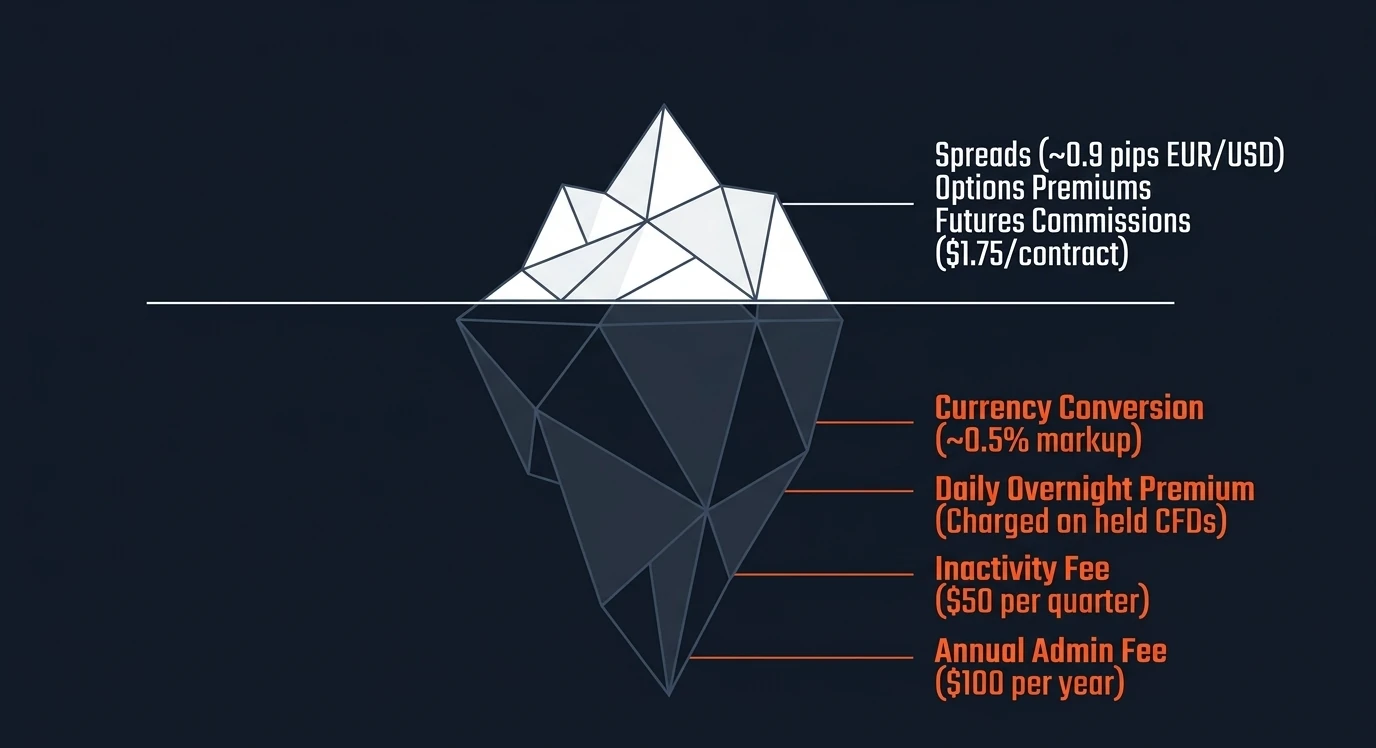
- Visible: spreads (~0.9 pips on EUR/USD), options premiums, and futures commissions (from $1.75 per contract plus exchange fees).
- Hidden: currency conversion (~0.5% markup), the daily overnight premium on held CFDs, a $/€/£50 inactivity fee every quarter, and a $/€/£100 annual administration fee.
Trading costs by asset class
Here is what you actually pay to trade the main asset classes. The pattern is consistent: no commission, but everything is a CFD, and every held position bleeds a daily financing charge.
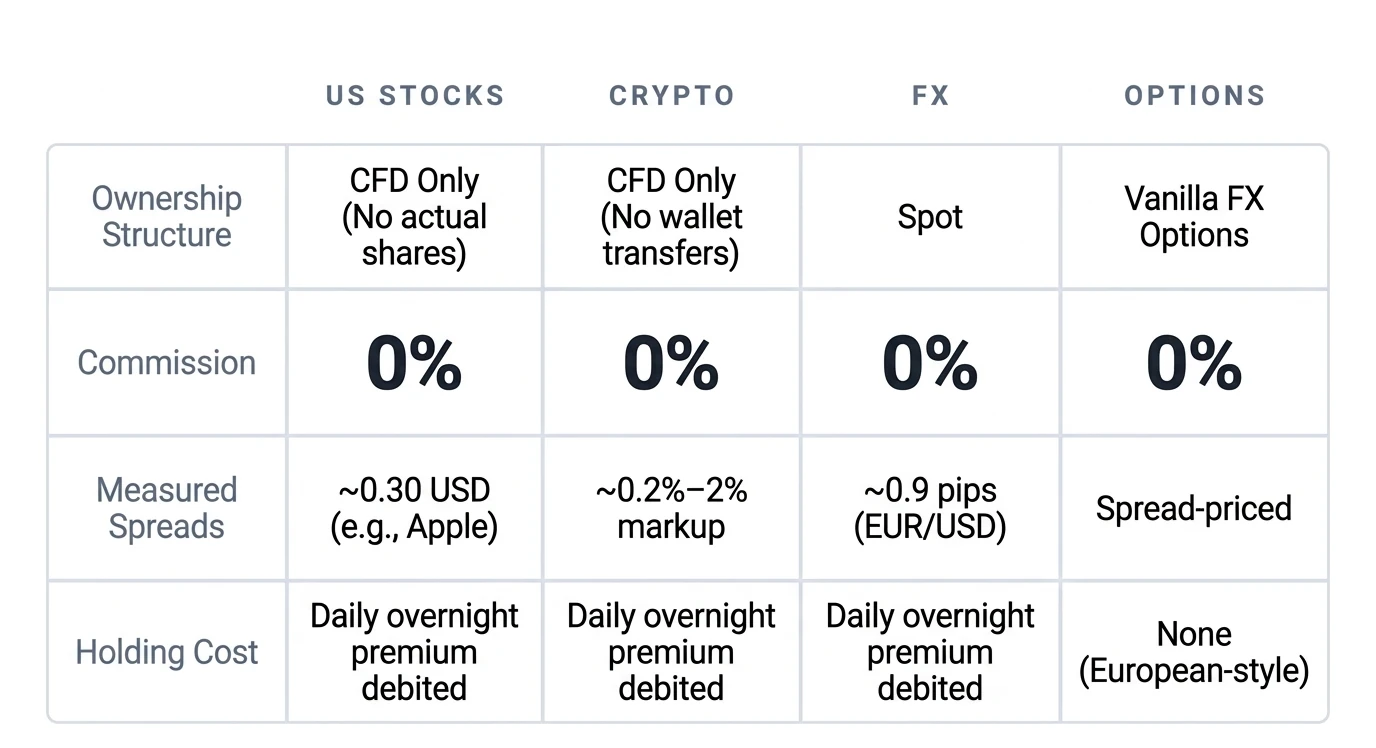
- US stocks: CFDs only — no actual shares. Spread of ~0.30 USD on Apple (around 0.13% over market on AvaTrade's published sheet). Daily overnight premium on held positions.
- European stocks: CFDs, spread-only, no minimum ticket. Because no shares change hands, there is no stamp duty or financial transaction tax — but coverage is limited.
- Crypto: CFDs only — no wallet transfers. Markup of roughly 0.2%–2% depending on the coin and volatility; trades 24/7 on MetaTrader.
- Forex: spot FX at ~0.9 pips on EUR/USD (~0.6 pips on the Professional account). One standard lot round-trip costs about $8–9.
- Options: vanilla FX options only (European-style), priced through the spread. In-the-money options are closed automatically at intrinsic value — no exercise or assignment fee. No stock or ETF options.
Currency conversion: the structural penalty
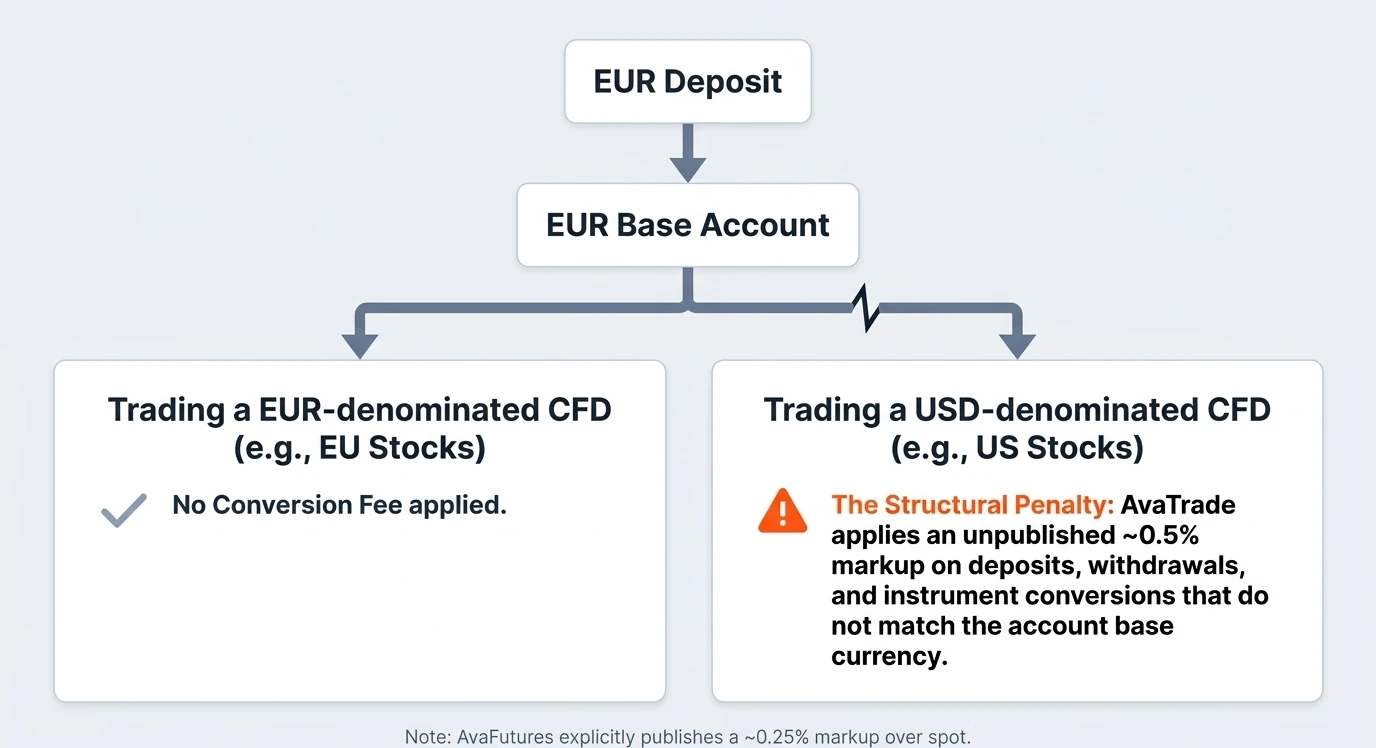
AvaTrade doesn't publish a conversion markup for its CFD accounts, but multiple independent reviews report around 0.5% whenever the currency of a deposit, withdrawal or instrument differs from your account's base currency. AvaFutures explicitly publishes ~0.25% over spot.
Inactivity & admin fees: the dormancy drain
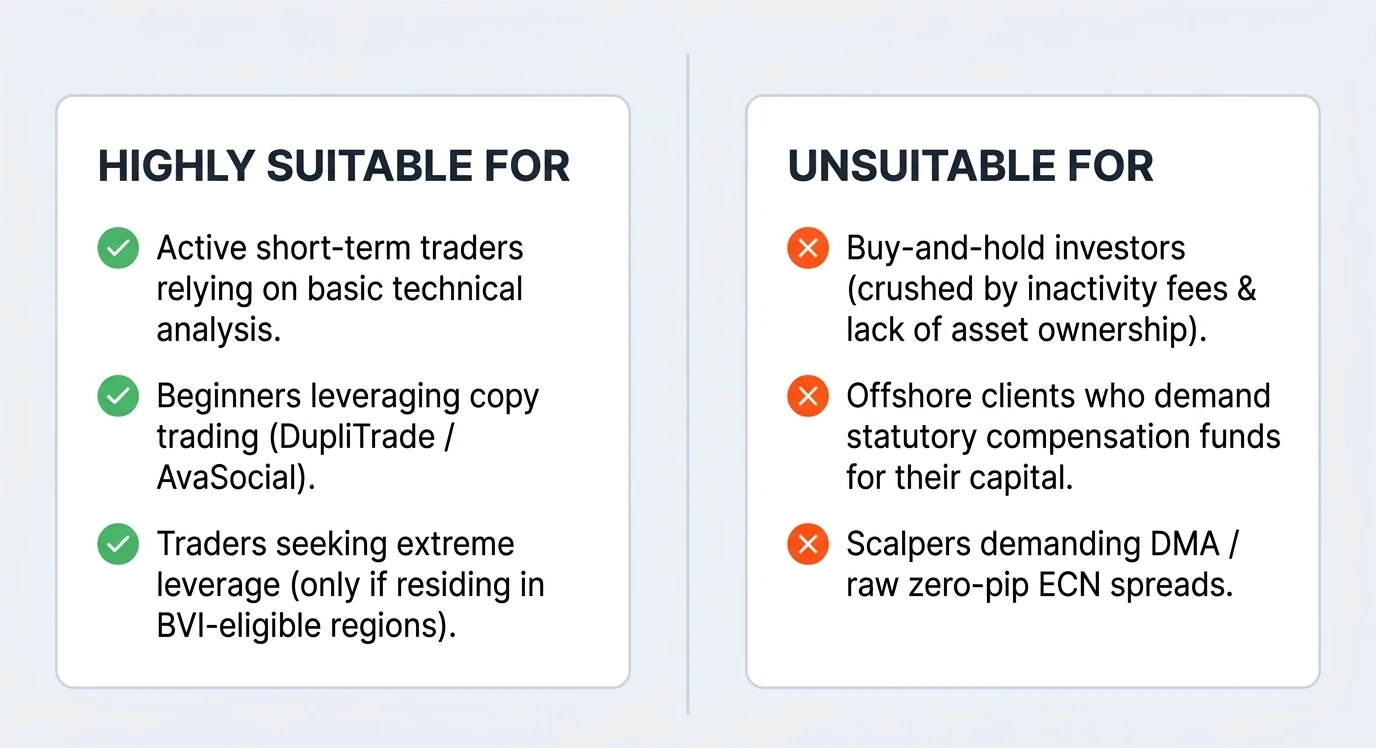
This is AvaTrade's most punishing cost for occasional traders. The clock starts after three consecutive months without activity, and it keeps running:
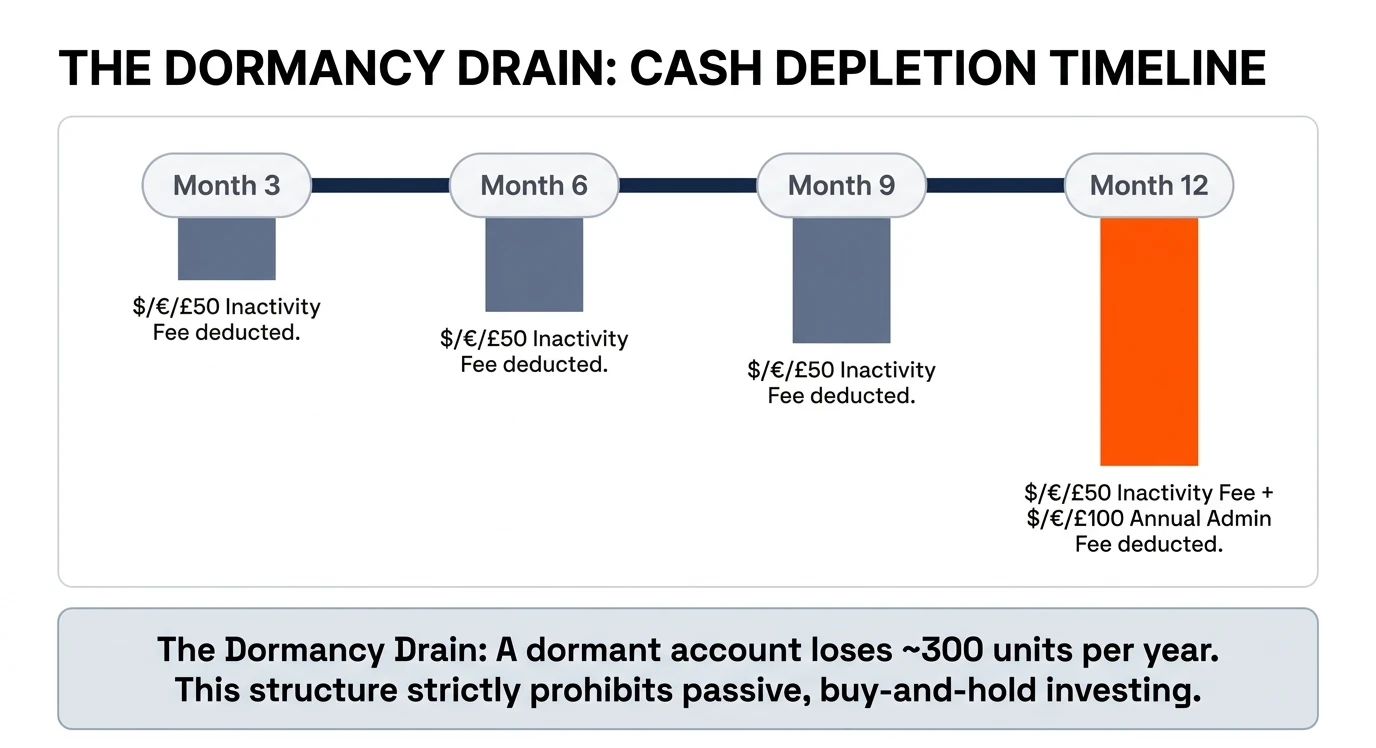
- Inactivity fee: $/€/£50 after 3 consecutive months without activity, then again every 3 months.
- Administration fee: $/€/£100 after 12 consecutive months of inactivity, charged annually.
- Total: about 300 units per year on a dormant account, deducted until activity resumes or the balance reaches zero.
Account types: Standard, VIP and Professional
AvaTrade runs a single core pricing model with three tiers layered on top. None of them introduce commissions — the differences are in spreads, leverage and perks.
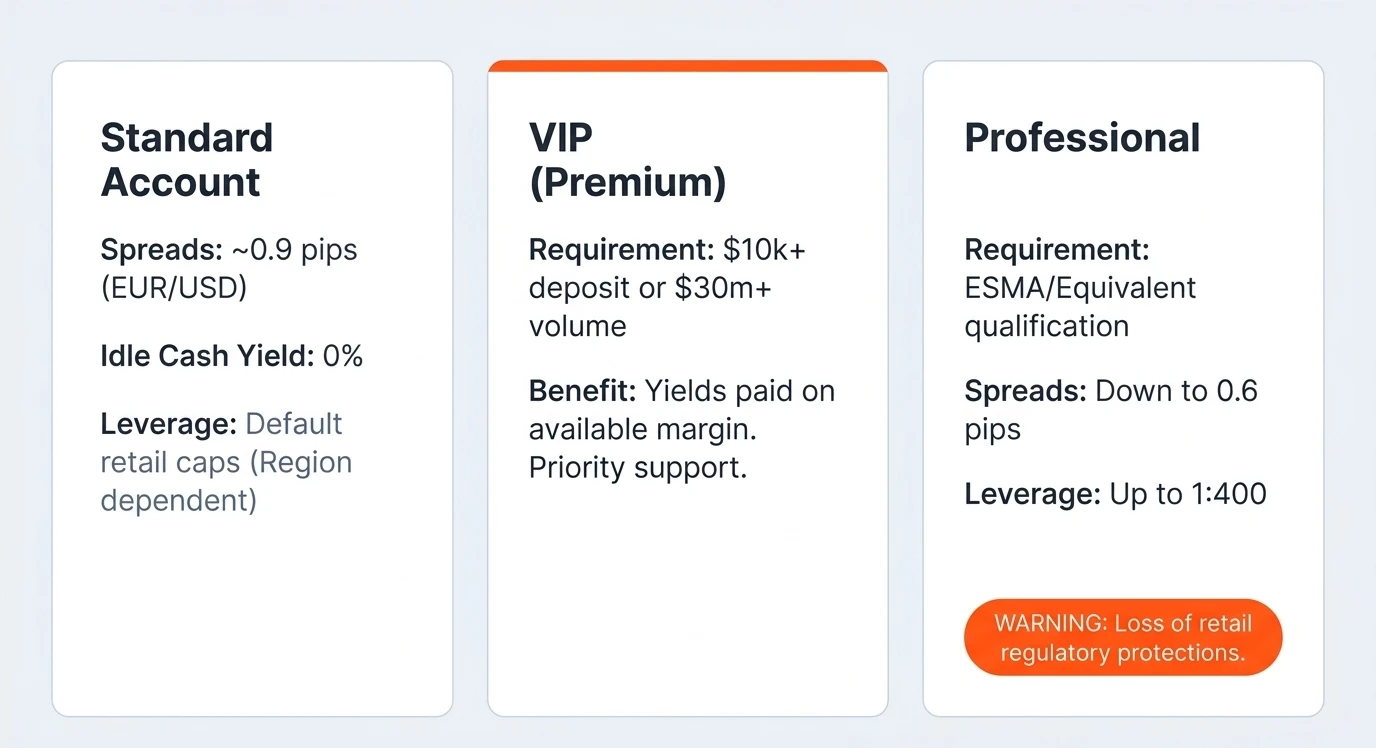
- Standard: ~0.9 pip EUR/USD spreads, 0% yield on idle cash, and leverage capped by your region's retail rules.
- VIP (Premium): for clients with $10,000+ in equity or $30m+ in trading volume. Interest is paid on available margin, plus priority support and faster withdrawals.
- Professional: requires an ESMA-style (or equivalent) professional qualification. Spreads drop to ~0.6 pips and leverage goes up to 1:400 — but you give up retail protections such as negative balance protection and leverage caps.
Interest on idle cash (VIP only)
Standard retail accounts earn nothing on uninvested cash. VIP clients with at least 10,000 in their own funds earn tiered interest, paid monthly:
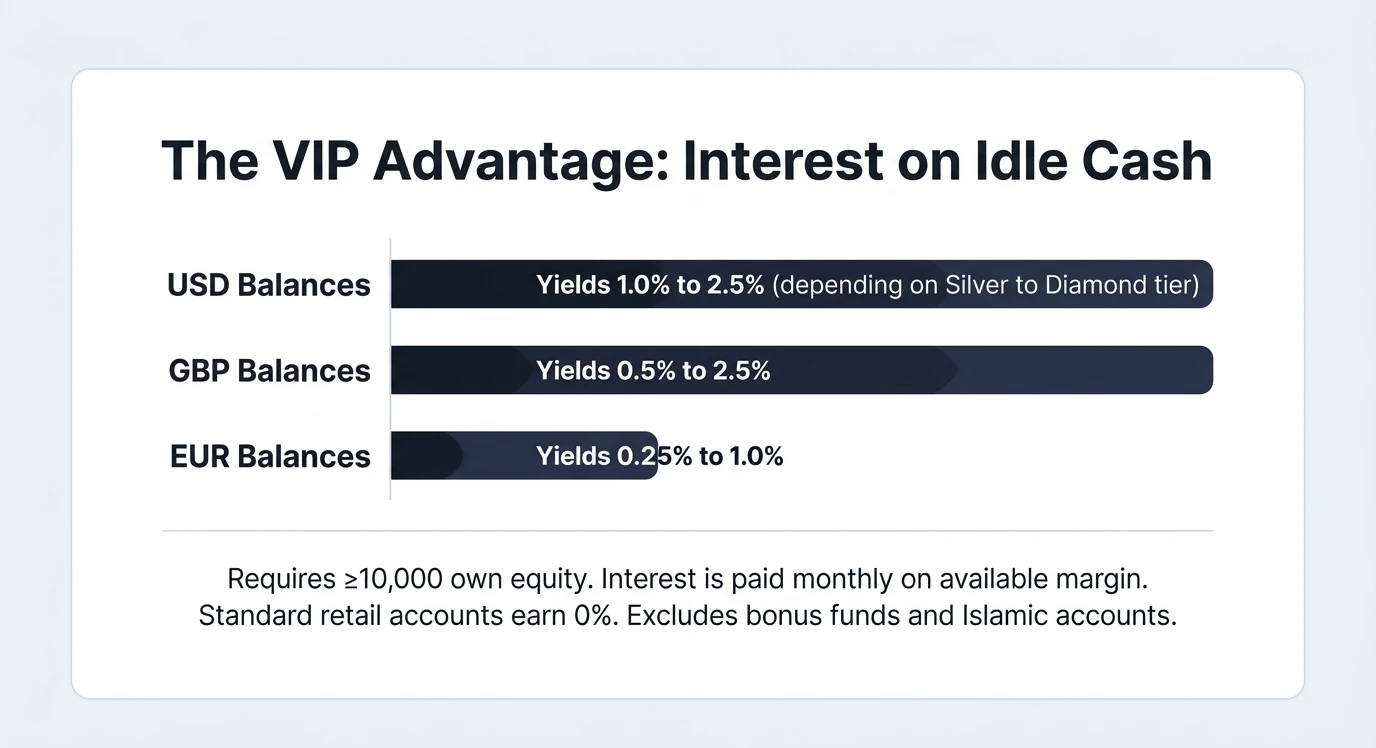
| VIP tier | USD | GBP | EUR |
|---|---|---|---|
| Silver | 1.0% | 0.5% | 0.25% |
| Gold | 1.5% | 1.0% | 0.5% |
| Platinum | 2.0% | 1.5% | 0.75% |
| Diamond | 2.5% | 2.5% | 1.0% |
Where AvaTrade operates
Which AvaTrade company opens your account depends entirely on where you live — and that decides your leverage, your protection and how disputes are handled.
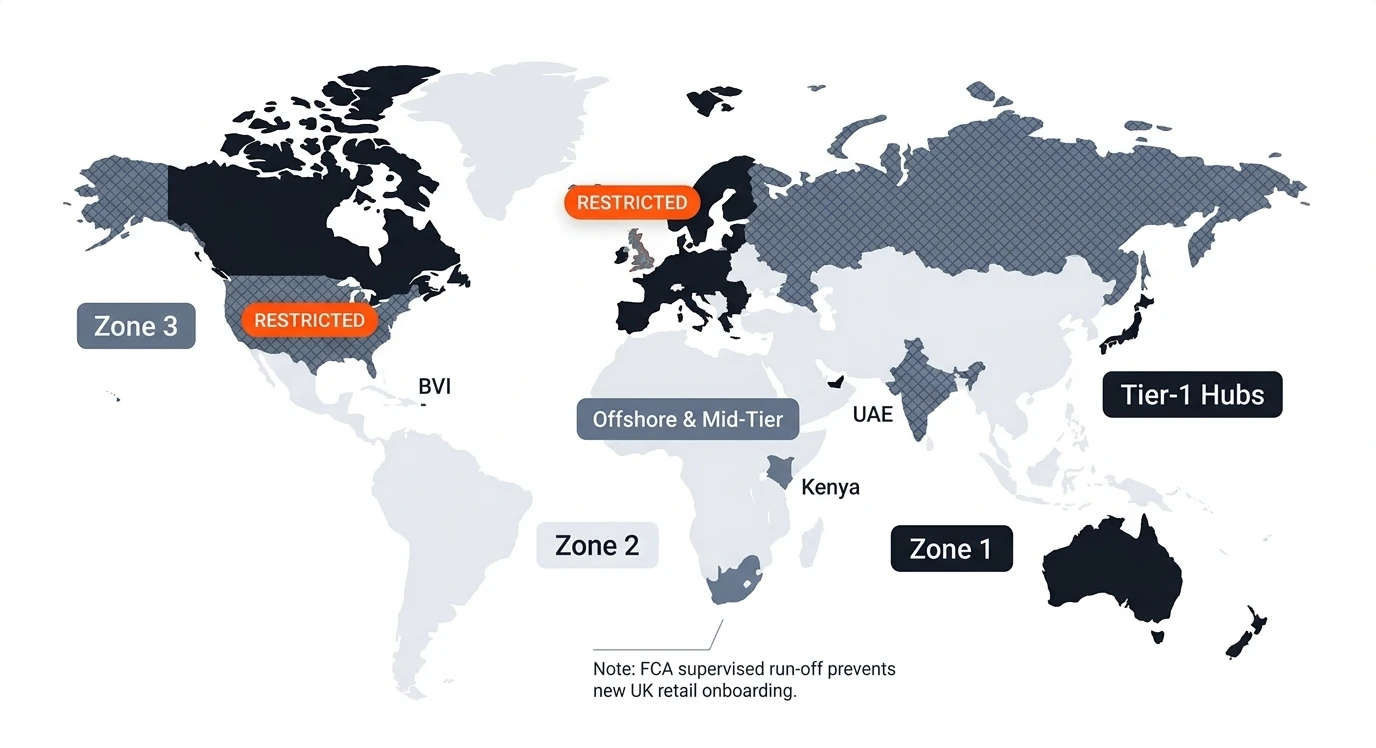
- Tier-1 hubs: EU/EEA (Central Bank of Ireland), Australia (ASIC), Japan (JFSA). Canada is served through partner Friedberg Direct (CIRO).
- Mid-tier: South Africa (FSCA), UAE (ADGM FSRA), Israel (ISA), Kenya (CMA).
- Offshore: most of Latin America, Asia and Africa are onboarded by Ava Trade Markets Ltd in the British Virgin Islands (BVI FSC).
- Not accepted: USA, UK, New Zealand, Belgium, India, Russia and sanctioned jurisdictions. There is no FCA-authorised entity, and new UK retail onboarding is closed.
Regulatory protection by entity
The product is identical everywhere. The safety net is not:
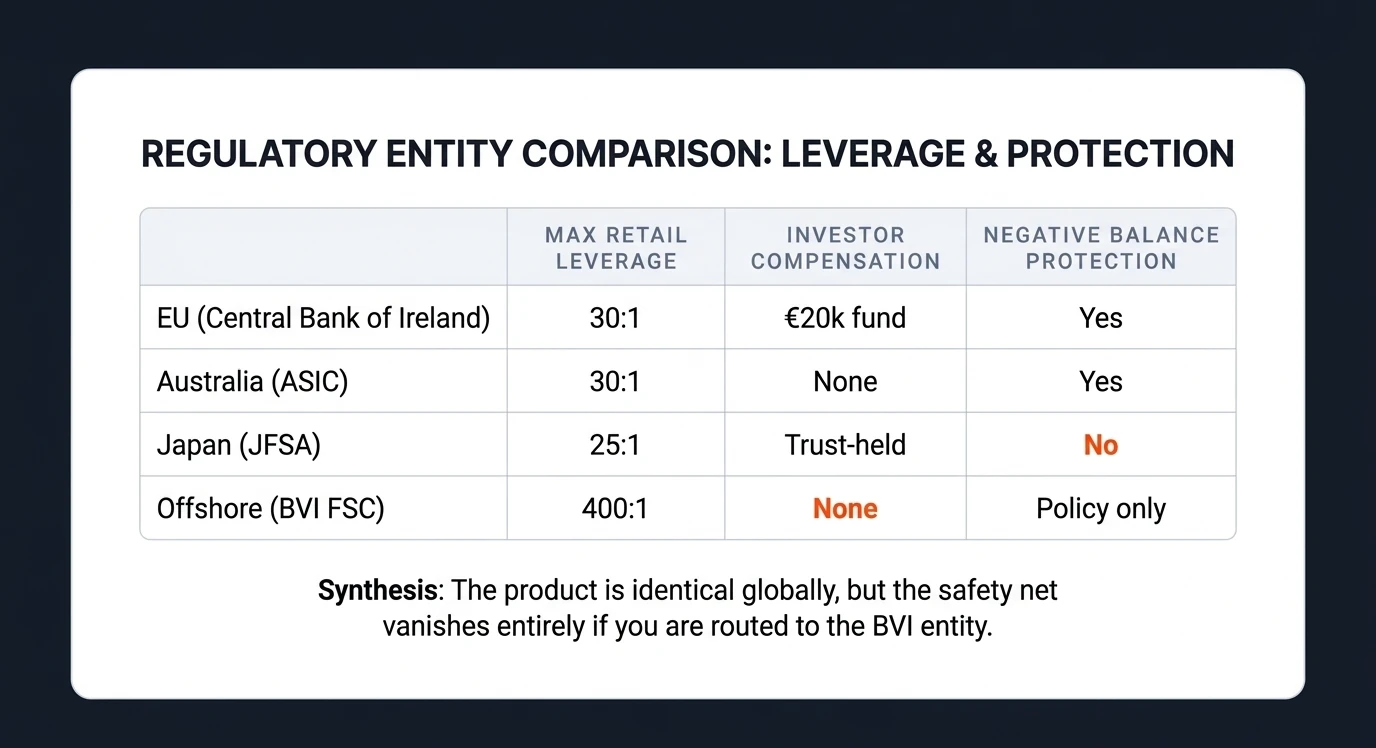
| Entity | Max retail leverage | Investor compensation | Negative balance protection |
|---|---|---|---|
| EU (Central Bank of Ireland) | 30:1 | 90% up to €20,000 | Yes |
| Australia (ASIC) | 30:1 | None (AFCA disputes) | Yes |
| Japan (JFSA) | 25:1 | Trust-held margin | No |
| Canada (Friedberg / CIRO) | CIRO limits | CIPF up to CAD 1M | Per CIRO rules |
| Offshore (BVI FSC) | 400:1 | None | Company policy only |
Platforms & what they cost
All core platforms are free to use. The cost differences come from the products each one unlocks:
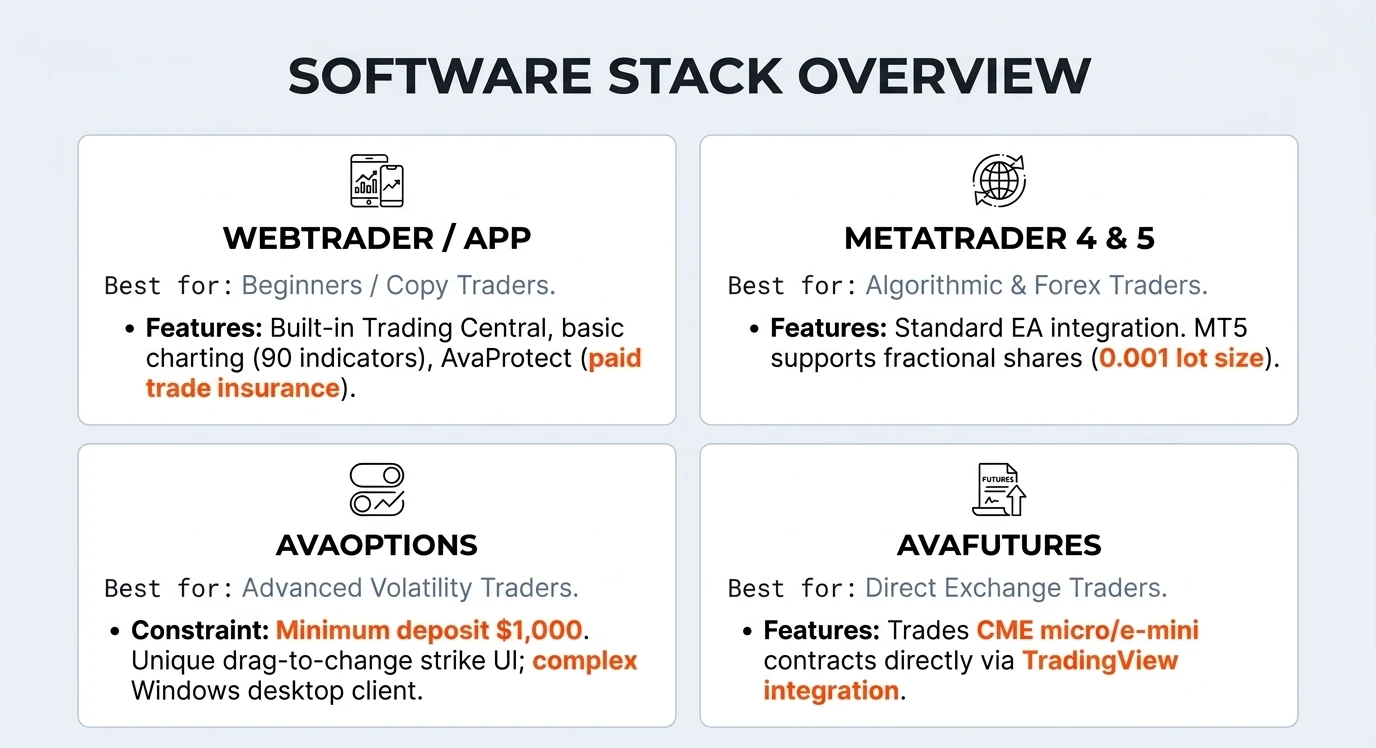
- WebTrader / AvaTradeGO: for beginners and copy traders. Includes Trading Central and basic charting. AvaProtect (paid trade insurance) is available in the app only.
- MetaTrader 4 & 5: for algorithmic and forex traders. MT5 supports fractional share CFDs from 0.001 lots.
- AvaOptions: for volatility traders — a dedicated FX options platform with drag-to-change strikes. Windows desktop client.
- AvaFutures: exchange-traded futures, including CME micro and e-mini contracts, with TradingView integration. Minimum deposit $1,000; per-contract commission plus exchange and NFA fees.
- Support: 24/5 by live chat, phone and email in ~14 languages. No weekend cover, even though crypto trades 24/7.
Deposits, withdrawals & other fees
| Item | Cost / rule |
|---|---|
| Deposit fee | None from AvaTrade (third-party fees may apply) |
| Withdrawal fee | None; 24–48h processing after verification; card deposits are refunded to the card first |
| Payment methods | Card and bank wire everywhere; e-wallets (Skrill, Neteller) outside the EU and Australia only |
| Overnight premium | Daily on held CFDs; weekend charge booked Wednesday (FX/metals) or Friday (others) |
| Market data / account fee | None |
| Portfolio transfer out | Not possible — CFDs can't be transferred |
| Tax reports | None — account statements only; you self-report locally |
Who is AvaTrade right for?
The WhichBrokr verdict
AvaTrade is a solid, multi-regulated market maker with good platforms and no commissions. Its real cost is hidden in conversion markups, holding fees and entity routing, so always check which company holds your account.